Your VP of Sales didn't work out. Now what?
Your VP of Sales didn't work out. Here is why it usually wasn't the person, what to do in the first two weeks, and the two moves that make it worse.
Ed Smith · 8 October 2026 · 9 min

If your VP of Sales didn't work out, start by assuming it wasn't the person. In most of the cases I see, the hire was asked to invent a motion that did not exist. Or to scale one before there was anything to scale. Or to sell into a customer profile that was wrong. What you do in the next two weeks matters more than who you hire next. Take the pipeline back. Re-qualify every deal. Call your top five economic buyers yourself. Then figure out which of the three failures you actually had before you post the job again.
It usually wasn't the person
Founders fire a VP of Sales and then describe the person. Not a closer. Didn't hire well. Couldn't forecast. Those things may be true. They are rarely the cause.
The first failure is the VP who was hired to invent a motion that did not exist. You were still the one selling. You hired a VP so that could stop. But nobody had written down who buys, why, through which committee, and what a qualified deal looks like. The VP walked into a job that was really a founder's job, with none of the founder's credibility. That usually fails and costs a year.
The second failure is the VP hired for scale before there was anything to scale. Big-logo résumé. Ran a team of forty. Knew how to manage a machine. There was no machine. There were six deals and a founder who closed them on relationships. The VP built process on top of nothing and the number went down.
The third failure is the ICP. The deals were in the wrong accounts, with the wrong buyer, at the wrong size. No VP could fix that from inside the sales team. Most "sales process" problems are ICP problems, and this one wears a sales leader's name on the way out.
The numbers say this is common. Gong reports that average VP of Sales tenure has dropped to 19 months (Gong). That is not a statistic about bad people. It is a statistic about jobs that were set up to fail.
SaaStr's advice is right, and it skips the step that matters most
Jason Lemkin answered this exact question at SaaStr. His list holds up. Take over sales yourself if nobody is ready. Consider an internal promotion as a bridge. Audit the process and the metrics. Start the search but do not rush it. Communicate with the team, keep deals moving, and hire the next person with a clear plan. The line I would underline is this one: "What you do need to do is have a plan" (SaaStr).
Where I would push harder is the order. Lemkin says audit the process. I would say the audit is useless until you are back in the pipeline yourself, deal by deal. The metrics you inherited from the VP were built on the VP's definitions. Revenue per lead and close rate mean nothing if "qualified" meant "someone took a meeting."
So the first two weeks are not a search. They are a reclaiming.
The first two weeks: take the pipeline back
Day one, every opportunity in the CRM is yours again. Not the team's. Yours. You are going to touch each one.
Re-qualify every deal against a standard, and write the standard down first if it does not exist. Mine has four parts. A named economic buyer who has met us. A problem they have described in their own words with a cost attached. A committee we can map: champion, economic buyer, IT, InfoSec, finance, procurement, and the incumbent. A next step with a date and an owner. A deal that fails two of the four moves to a different stage or out of the forecast.
Call the top five economic buyers yourself. Not the champions. The people who sign. Tell them there has been a change on your side and that you are personally on the account. Then ask one question: where does this sit on your list this quarter. You will learn more in five calls than the last quarter of pipeline reviews told you. Some of those deals will be real and relieved to hear from you. Some will have been hope with a close date.
Stop the bleeding in the forecast on the same day. Pull every deal that fails the standard out of commit. Your board number will drop. It was already wrong, and a smaller true number is worth more than a larger false one. Most early-stage forecasts are feelings with a spreadsheet around them, and a departed VP's forecast is usually the purest example.
Then tell the reps what you found and what the standard is now. They will be rattled. A clear standard calms a team faster than a pep talk.
Two things that feel better and make it worse
The first is hiring the next VP in thirty days. It feels decisive. It is the same mistake with a new name on it. You have not diagnosed which failure you had. You have not written the motion the new person will inherit. You will hand them the same job that broke the last one, and the tenure clock starts again.
The second is promoting the top rep because they are there. Sometimes it works. Usually it costs you your best seller and gives you a manager who has never built a qualification standard. Never run a forecast on evidence. Never told a founder no. If you promote, call it interim, name the date you will revisit it, and keep them carrying a number.
There is a quieter third mistake. Deciding the whole idea of a VP of Sales was wrong and going back to founder-led sales for good. That is not a plan either. It is the first failure, delayed. I have written about when do you need a VP of Sales, and the short answer is that the trigger is committee complexity, not the calendar.
Diagnose which failure you had before you fix anything
The three failures look alike from the board deck. They separate fast once you are back in the deals.
Look at the deals that closed in the last four quarters. If you were on every one of them at the economic-buyer stage, the VP never owned a motion. They owned a status meeting. That is the first failure. The motion has to be built before anyone else can run it.
Look at what the VP built. If there is a process document, a hiring plan, a forecasting cadence and a comp plan, but the pipeline did not grow, that is the tell. You hired for scale before there was anything to scale. That is the second failure. The process was not wrong. It was early.
Look at the lost deals and the no-decisions. If the economic buyer was the wrong title, the accounts were the wrong size, or the problem you solve was a nice-to-have for the people you sold to, it was the ICP. That is the third failure, and the VP was the last person who could have fixed it. If the loss reasons cluster on "no budget" and "went with the incumbent," read late-stage stalls are power-base problems before you blame anyone.
Most founders find some of each. Pick the one that explains the most lost revenue and fix that first.
The rebuild sequence
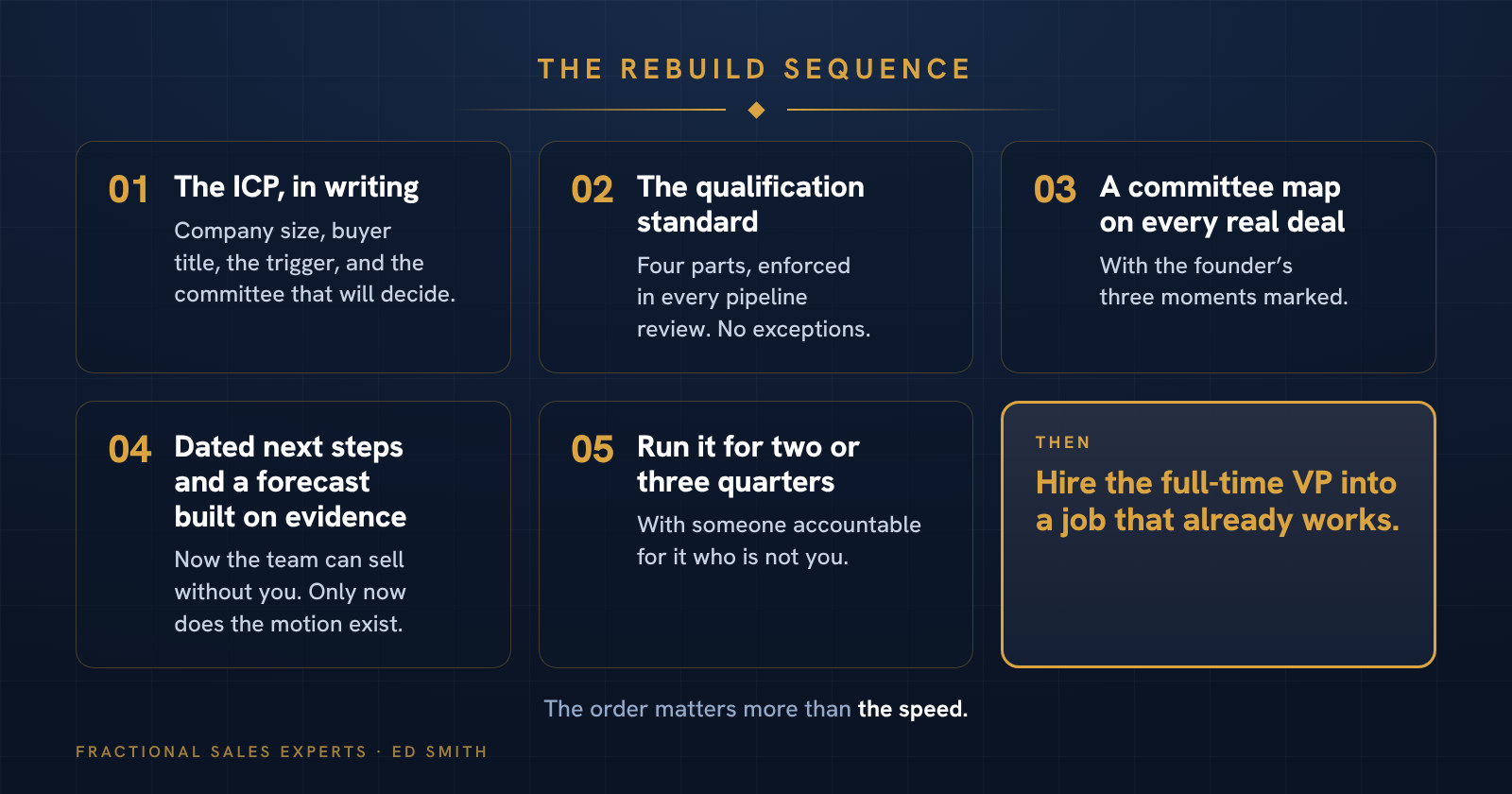
The order matters more than the speed.
First, the ICP, in writing. Company size, buyer title, the trigger that makes the problem urgent, and the committee that will decide. If you sell software into retailers, the trigger is usually a merchant calendar or a planned system change, and the committee includes the incumbent (selling software into retailers).
Second, the qualification standard. The four parts above, enforced in every pipeline review. No exceptions for the deal you really want.
Third, a committee map on every real deal, with the founder's moments marked. You belong in the first real conversation with the economic buyer, in late-stage alignment while risk still sits with the committee, and in the final commercial conversation on non-standard terms. You do not belong in discovery, demos or status meetings (when the founder should show up).
Fourth, dated and owned next steps and a forecast built on evidence. Once those exist, the team can sell without you for the first time. Only now does the motion exist.
Fifth, run the motion for two or three quarters with someone accountable for it who is not you. Then hire the full-time VP into a job that already works.
Where a fractional VP of Sales fits
A fractional VP of Sales fits in the gap between step one and step five. The motion has to be built and run before it can be handed to anyone. Most founders cannot build it alone while carrying the number, and most companies at this stage should not spend another year and another loaded salary finding out.
I come in for two days a week, usually. I own the qualification standard, the committee map, the forecast and the weekly cadence. I run the motion with you for a few quarters. You stay in the three moments that need you. The reps get a standard and a cadence instead of a vacancy.
Then I run the next hire so it does not fail on arrival. I write the scorecard from the motion that now exists, interview against it, and onboard the person into a system with real deals in it. The ending is named at the start, before the first invoice. That is what I help founders run. It is also where the model was proven. Standard AI was client zero, where I rebuilt the GTM through a product pivot as VP of Sales reporting to the CEO.
Not every founder needs this. If you have a written motion, a forecast you trust, and a rep who can run discovery without you, hire the VP and skip me. You can check the fit in two minutes before we talk.
What to do about it
Take the pipeline back this week. Every deal, yours, re-qualified against a written standard.
Call the top five economic buyers yourself. Ask where the deal sits on their list this quarter and write down the answer.
Cut the forecast to what passes the standard. Tell the board the smaller true number and why.
Diagnose which failure it was. No motion, too early for scale, or wrong ICP. Pick the one that explains the most lost revenue.
Do not post the VP job yet. Write the ICP and the qualification standard first, so the next person inherits a job and not a vacancy.
Decide who runs the motion for the next two or three quarters. You, an interim with a revisit date, or a fractional VP of Sales who builds it and then helps you hire into it.
Questions founders ask
I fired my VP of Sales. What now?
Take the pipeline back personally before you do anything else. Re-qualify every deal against a written standard, call your top five economic buyers yourself, and pull every deal that fails the standard out of the forecast. Then diagnose which failure it was. A VP asked to invent a motion that did not exist, one hired for scale before there was anything to scale, or one set up to sell into the wrong ICP. Hire the next person only after the motion is written down.
Should I promote my top rep to VP of Sales?
Usually not, and never permanently in the first thirty days. Your best seller has probably never built a qualification standard, run a forecast on evidence, or told a founder no. If you promote, call it interim, keep them carrying a number, and name the date you will revisit it. Losing your top rep to a management job they are not ready for is the expensive version of this decision.
How fast should I hire a new VP of Sales after firing one?
Not in thirty days. Hiring fast feels decisive and repeats the mistake. The next VP should inherit a written ICP, a qualification standard, a committee map on every real deal, and a forecast built on evidence. If those do not exist yet, build and run them first, usually for two or three quarters, then hire into a job that already works.
Why do VPs of Sales fail at startups?
Three reasons account for most of it. They were hired to invent a motion that did not exist, which is the founder's job. They were hired for scale before there was anything to scale. Or the ICP was wrong and no sales leader could fix it from inside the sales team. Gong reports average VP of Sales tenure has fallen to 19 months, which says more about how the jobs are set up than about the people in them.
How do I know if the problem was my VP of Sales or my ICP?
Read the lost deals and the no-decisions from the last four quarters. If the economic buyer was the wrong title, the accounts were the wrong size, or the problem you solve was a nice-to-have for the people you sold to, it was the ICP. If the accounts were right but the VP never got past the champion to the economic buyer, it was the motion. Most "sales process" problems turn out to be ICP problems.
Should I take over sales myself after firing my VP of Sales?
Yes, for the first two weeks, and in three specific moments after that. Take the pipeline back, re-qualify it, and call the economic buyers yourself. Then stay in the first real conversation with the economic buyer, late-stage alignment with the committee, and the final commercial conversation. Get out of discovery, demos and status meetings, or you will be the bottleneck the next VP is hired to remove.
What does a fractional VP of Sales do after a failed VP hire?
Builds and runs the motion the last hire did not inherit. That means a qualification standard, a committee map on every real deal, dated and owned next steps, and a forecast built on evidence. The fractional leader runs that motion for a few quarters alongside the founder. Then runs the next full-time hire against the motion that now exists, so the new VP walks into a working job instead of a vacancy with a quota.
More on the work: Advisor, fractional VP of Sales and special projects · Check the fit
More notes

A Valley founder's first enterprise deal
What the first enterprise deal looks like for a Greater Phoenix founder, and what changes when your startup sales leader in Phoenix can sit in the deal review.

Your first sales hire: a leader or a rep?
Should your first sales hire be a leader or a rep? Usually neither, yet. The answer depends on whether a motion exists, and most founders hire before it does.