When do you need a VP of Sales?
When do you need a VP of Sales? Not full-time yet, but sooner than you think. The deal signals, your three options, and when to hire a fractional VP of Sales.
Ed Smith · 24 September 2026 · 9 min

When do you need a VP of Sales? My honest answer: not full-time yet, but sooner than you think. The moment arrives when your deals get complicated faster than you can be in all of them. So the real question is not "what is my ARR," it is "what is happening inside my deals." That is also the question underneath when to hire a fractional VP of Sales.
The signal is in your deals, not your ARR
Founders think about this in an ARR window, and the window is roughly $1M to $5M. That is a fair place to start thinking. It is a bad place to decide.
I've seen companies at $800K that needed sales leadership last quarter. I've seen companies at $4M that didn't, because the founder was running a clean, repeatable motion and liked doing it. Revenue tells you how much you've sold. It doesn't tell you how hard the next deal will be.
The trigger is committee complexity. Here is what it looks like from the inside.
- A deal stalls after a great demo and nobody can say why.
- A second buyer shows up late, someone from IT, InfoSec, finance or procurement, and you've never heard their name.
- You have a pilot running with no decision date attached to it.
- Your forecast is a list of deals you feel good about.
- You are in every call, because the deal moves only when you are.
If three of those are true, you need sales leadership. Not a title. Leadership. Someone who owns the motion on Monday morning so you can stop being the motion.
The deal that stalls after a great demo is the loudest signal
Early deals are usually won by one person, your champion. They love the product. They get the demo. They tell you this is going to happen.
Then nothing happens. The champion goes quiet, or keeps saying "soon." What changed is that the deal left the champion's desk and entered the committee. Enterprises buy through a champion, an economic buyer, IT, InfoSec, finance, procurement, the field, and the incumbents already in the building. Founders sell the first person and get surprised by the other five.
An enthusiastic contact is not late stage if the economic buyer has never heard your name. That's hope, not a forecast. When you notice you've been forecasting hope, that is the moment. I wrote more about this in late-stage stalls are power-base problems.
You have three options at that moment, and all three can be right
Keep going as founder. Right when you have fewer than three real enterprise deals in flight, when your deals have one or two buyers, and when you genuinely want to sell for another year. It is wrong when the thing stalling your deals is you, specifically your calendar.
Hire a full-time VP of Sales. Right when the motion already exists and needs scale. You know who buys, why, and through whom. You have a qualification standard reps actually use. You can hand someone a playbook and a quota and both are honest. If you can't describe the motion in two pages, you don't have one to hand over.
Bring in a fractional VP of Sales. Right when the motion does not exist yet, deals are getting more complicated, and you can't afford to spend a year learning what a sales leader learns in a quarter. It's also right when you want to make the full-time hire later, but correctly. I wrote about the difference between a fractional CRO vs fractional VP of Sales if the title question is what's bugging you.
The founder who picks wrong usually picks option two too early. Not because they're careless. Because they're tired of selling and a VP of Sales looks like the way to stop.
Hiring full-time too early costs you a year
A full-time VP of Sales hired to invent a motion that doesn't exist usually fails. The failure is not a character flaw. You hired someone to run a machine and handed them a workshop with no machine in it.
The numbers are not kind. On the SaaStr podcast, SalesCollider founder Ryan Williams put the failure rate of first VPs of Sales at early-stage startups at 70%. Gong's analysis puts average VP of Sales tenure at about 19 months, down from 26. In a seed or Series A company, the early-hire version of those numbers is worse.
Here is what the failure actually costs. Three months to recruit. Three months to ramp. Three months of the new VP hiring reps against a motion they're still guessing at. Three months of you noticing the pipeline is worse and deciding what to do. That's a year, plus salary, plus equity, plus the reps who came in under them and now need a new leader.
Hiring a big-logo AE into a seed-stage company fails for the same reason. They've run a motion. They've never built one.
What a fractional VP of Sales does at that stage instead
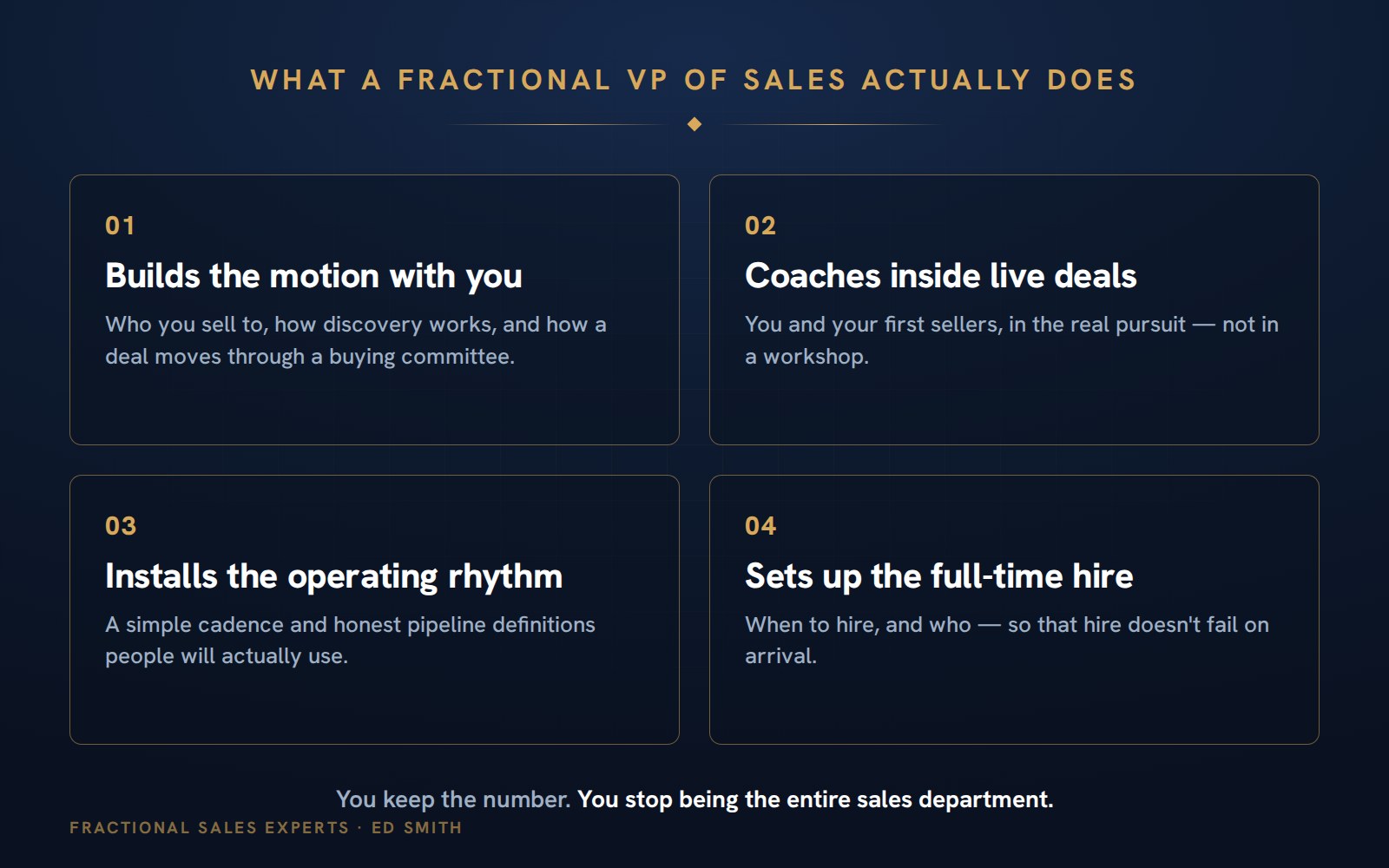
A fractional VP of Sales builds the motion with you, inside your live deals, before anyone is asked to scale it. (Why founders hire one covers the partnership side; this section covers the work.) That means four things, and I do them in roughly this order.
First, a qualification standard. Written down, and used. Most "sales process" problems are ICP problems, so this is where I start. If half your pipeline is accounts that were never going to buy, no process fixes that.
Second, a committee map on every real deal. Who is the champion, who is the economic buyer, who in IT and InfoSec can say no, where is finance, where is procurement, who is the incumbent. If we can't fill in the map, the deal isn't late stage, whatever the CRM says.
Third, dated and owned next steps. A pilot with no decision date is a science project. Every real deal has a next step with a name and a date on it, on the customer side as well as ours.
Fourth, a forecast built on evidence. Most early-stage forecasts are feelings with a spreadsheet around them. A deal moves into commit when the committee map is complete, the economic buyer has met us, and the paper is moving. Not before.
While that gets installed, I'm coaching inside your live deals. Pre-call plans, post-call debriefs, who to bring in, when you as founder belong in the room and when you don't. I wrote the rule for that in when the founder should show up. You belong in three moments. Not early discovery, not demos, not status meetings, and never price as a rescue.
And the ending is named at the start. Ninety days minimum, then thirty days' notice. The engagement ends one of three ways: a motion that runs without me, a full-time hire I help you make, or continued advisory. If the end is a full-time VP of Sales, the job is to make that hire land, with a real motion, a real forecast, and a team already working to a standard. That is what I mean by fractional VP of Sales, and you can see what I help founders run in more detail.
You can tell in thirty days whether it's working
Thirty days is enough. Not to close the quarter, but to know whether the motion is forming. Here is what I'd look for, and what I'd hold myself to.
- There is a written qualification standard, and the last five deals added to pipeline pass it.
- Every deal in the forecast has a committee map, with named gaps instead of hopeful blanks.
- Every real deal has a next step that is dated and owned, including on the customer's side.
- The forecast has moved. Usually down. That's the point. A forecast that got smaller and more honest is a forecast you can run a company on.
- You have left at least one recurring meeting you used to run.
- At least one stalled deal has moved, because someone who can say yes finally met you.
If none of that has happened in thirty days, something is wrong, and it might be me. Say so. A fractional engagement is easy to end, which is one of the reasons it's the right first step.
What to do about it
Here is what I'd do this week if you're asking the question.
- Pull your top ten deals and write the committee map for each. Count how many have an economic buyer you've actually met. That number tells you how early you really are.
- Write your qualification standard on one page. If you can't, that's the first thing a sales leader will do, and the reason not to hire one full-time yet.
- Look at your calendar. Count the hours in demos, status meetings and early discovery. That is the time a motion would give back to you.
- Decide what the ending looks like. Full-time hire in twelve months? A motion you run yourself? Say it now, so you can judge any option against it.
- If you are still carrying the number and the deals are getting more complicated, talk to someone who has built the motion before. You can check the fit in two minutes, or read who I work with first.
Investment is scoped on the first call.
Questions founders ask
At what ARR do you need a VP of Sales?
Founders usually ask this in the $1M to $5M ARR window, and that is a fair range to start thinking. But ARR is not the trigger. The trigger is how many people are involved in your deals, and whether you can still be in every one of them. A company at $1M with six-person buying committees needs sales leadership before a company at $4M selling to a single buyer.
When should I hire a fractional VP of Sales instead of full-time?
Hire fractional when the sales motion doesn't exist yet and the deals are getting more complicated. A full-time VP of Sales is for scaling a motion that already works. A fractional VP of Sales builds the motion inside your live deals, installs the operating rhythm, and then helps you make the full-time hire when there's something real to hand over.
Is it too early to hire a VP of Sales at seed stage?
Usually, yes, for a full-time hire. At seed stage the motion is still being discovered, and a full-time VP hired to invent one tends to fail and cost a year. What seed-stage founders usually need is sales leadership on the deals they have now, and a standard for which deals to take. That is a fractional job, or the founder's job with coaching.
What are the signs you need a VP of Sales?
Deals that stall after a strong demo. Buyers you've never met showing up late. Pilots with no decision date. A forecast built on how you feel about each deal. And a founder who is in every call, because the deal only moves when they're on it. Three of those five is enough.
What does a fractional VP of Sales do that a full-time one doesn't?
The job is the same on the inside. The difference is timing and scope. A fractional VP of Sales comes in before the motion exists, builds it in the live deals, and sets the company up to hire full-time correctly. The engagement is ninety days minimum with the ending named up front, so it's a smaller bet than a full-time hire made a year too early.
How long does it take to know if a VP of Sales is working?
Thirty days is enough to know whether a motion is forming. By then there should be a written qualification standard, committee maps on every forecasted deal, dated next steps, and a forecast that has gotten smaller and more honest. Closed revenue takes longer. The structure doesn't.
Should the founder keep selling instead of hiring anyone?
Sometimes. If you have one or two buyers per deal, fewer than three real enterprise deals open, and you want to sell for another year, keep going. The founder belongs in three moments: the first real conversation with the economic buyer, late-stage alignment when risk still sits with the committee, and the final commercial conversation. If you're in every other moment too, that's the problem.
More on the work: Advisor, fractional VP of Sales and special projects · Check the fit
More notes

They never met the economic buyer
A founder lost a deal he should have won because he never met the person who signs. What founders miss about navigating a large company, and how to fix it.

Why founders hire a fractional VP of Sales
Founders don't need another salesperson. They need a senior partner who owns revenue with them. What a fractional VP of Sales brings, and when it fits.