Your first sales hire: a leader or a rep?
Should your first sales hire be a leader or a rep? Usually neither, yet. The answer depends on whether a motion exists, and most founders hire before it does.
Ed Smith · 5 October 2026 · 10 min

Should your first sales hire be a leader or a rep? The honest answer is that it depends on whether a sales motion exists yet. At most seed and early Series A companies it does not. In that case the right first sales hire is usually neither. It is the founder plus a senior counterpart who builds the motion beside them, followed by a first seller who can build, not just run.
I have made and watched this hire for 30+ years inside large enterprise sales organizations. Now I make it as a fractional VP of Sales for founders selling complex software. The two most common versions fail for the same reason. This is why, and what to do instead.
The question has a prior question: does a motion exist?
"Leader or rep" assumes there is something for the person to lead or to run. Often there is not.
A motion is not a CRM with stages in it. It is a written answer to four questions. Who exactly buys this, and what trigger makes them buy now? Who else has to say yes, and in what order? What does a qualified deal look like, and what does a dead one look like? What has the buyer done, not said, that puts a deal at each stage?
If those answers live in the founder's head, there is no motion. There is a founder who is good at selling. A rep cannot copy what is not written down, and a leader cannot manage what has not been defined.
So the first decision is not leader or rep. It is whether you are hiring someone to run a thing, or to build a thing. Those are different people, and almost nobody is good at both.
The big-logo AE from a large company usually fails at seed stage
This is the hire that looks safest. A senior AE from a well-known software company, President's Club, big quota, big logos on the resume.
Here is what that person had at their last job. An inbound engine. A brand the buyer already trusted. Two SDRs setting their meetings. A sales engineer for every demo. A deal desk for pricing. Legal for redlines. A manager who had already decided which accounts to work.
They were excellent at the last mile. They have never built the first ten.
At your company there is no brand, so the first call is a cold one. There is no SDR, so they book it themselves. There is no sales engineer, so they demo. There is no playbook, so they write one. More often they do not, and they run the one from their last company against a buyer it was not built for.
Mike Molinet, co-founder of Branch, said it plainly in First Round's first-sales-hire guide: "Hiring late-stage, coin-operated people almost never works for early stage." Jacquelyn Goldberg added in the same piece that a Rolodex is the lowest thing on the list to hire for.
Even in a company with a working motion, ramp is slow. The Bridge Group's 2026 research across 158 B2B companies puts average AE ramp at 6.2 months, the longest in the study's history. Only 48% of reps hit annual quota. That is the ramp when the playbook, the leads and the brand already exist. Without them, a seller built for that environment does not ramp. They stall, and then they leave.
A VP of Sales hired to invent the motion fails too, and costs a year
The other safe-looking hire is the leader. A VP of Sales who will "own revenue" so the founder can get back to product.
The logic seems sound. Senior person, has scaled teams, knows process. Hire them, hand them the number, step back.
The problem is the same as the AE's, one level up. A VP from a scaled company knows how to run a motion. They have hired into one, forecasted one, reported one to a board. They have rarely had to discover one, because by the time they arrived, the founders had already done that.
So the VP does what they know. They build a team and a process before there is a repeatable deal to build it around. Six months in, there are three reps, a tech stack and a pipeline review, and the founder is still the one closing. By Jason Lemkin's count, about 70% of first VP of Sales hires don't make it, and he says a mishire sets you back a year. I think a year is generous.
Founders make this hire to stop selling. I understand that. But the fix for a founder who is tired of selling is not a leader hired to pretend the motion exists. I wrote the longer version in when do you need a VP of Sales.
The first seller should be a builder
If the big-logo AE fails and the early VP fails, who is the right first seller? Someone who has built a motion before, at a company where there was not one yet.
That person has a specific history. They joined a company at or before its first million in revenue. They had no brand behind them and no one booking their meetings. They figured out who actually buys, worked the committee themselves, wrote the first talk track and then rewrote it when it did not work. They closed deals that nobody at the company had closed before.
Builders are usually not the people with the biggest logos. They are often the second or third seller at a company you have heard of. They were there when nobody had heard of it. Their resume looks less impressive and their references are more interesting.
The builder also has to be comfortable selling beside the founder, not instead of them. Early on, the founder is still the best seller in the building. The first seller's job is to make the founder's motion repeatable, not to replace it on day one. I wrote about the moments the founder should keep in when the founder should show up.
What to look for in the interview
Interviewing for a builder is different from interviewing for a closer. Quota attainment at a scaled company tells you almost nothing. These are the questions I ask, and what I am listening for.
Tell me about a deal you built from nothing. Not a lead that came in. An account where you found the trigger, found the people, and created the deal. I want to hear the specific person they went around to get to the economic buyer, and what they said.
Walk me through the committee on your biggest deal. Enterprises buy through a champion, an economic buyer, IT, InfoSec, finance, procurement, the field and the incumbents. A builder can name all of them on a deal from two years ago and tell you which one nearly killed it. A closer names the champion and the signer.
What did you do when the pitch stopped working? Builders have a story about a talk track that failed and what they changed.
How did you book your meetings at your last company? If the answer is "the SDR team," that is not disqualifying, but keep going. Ask what they did in the months before the SDR team existed, or at the job before that.
What was it like selling without a brand? Listen for whether they have done it. A seller who has only ever sold a product the buyer already wanted does not know yet whether they can do the other thing.
Then do a live exercise against your real buyer. Give them your ICP and a one-page summary, and have them run the first fifteen minutes of a discovery call with you as the buyer. You are not grading polish. You are grading whether they ask about the trigger, the committee and the decision date, or go straight to the demo.
Shape the comp for building, not for running a number
I am not going to give numbers here, because the numbers depend on your market, your deal size and your stage. The shape matters more than the numbers, and most founders get the shape wrong.
A standard AE plan, roughly half base and half variable, assumes the rep controls enough of the outcome to earn the variable. At a company with no motion, they do not. Pipeline does not exist yet. Cycles are unknown. The first two quarters are discovery, not closing.
So the early shape leans toward base. The variable component is real but smaller. It pays on what a builder can actually control in the first two quarters. Qualified opportunities created against the written standard. Committee maps completed. Deals advanced to a stage with buyer evidence behind it.
Quota comes after a motion exists, not before. A quota set before anyone has closed a repeatable deal is a guess, and the rep knows it is a guess. It either demotivates them or teaches them to argue about the number instead of selling. Set the quota once two or three deals have closed through the written motion. By then you know what a cycle and an average deal actually look like.
Equity matters more to a builder than to a runner. They are taking the risk that the motion does not work. Pay for that risk in the thing that rewards it if it does.
The sequence I use for enterprise, and why SDR-then-AE-then-manager is wrong
There is a standard sequence in a lot of startup advice. Hire an SDR first to generate pipeline, then an AE to close it, then a manager at three reps. It works for transactional products with short cycles.
It does not work for complex enterprise deals. An SDR with no motion books meetings with the wrong people at the wrong accounts. The founder, already stretched, now has to take those meetings. An AE hired to close pipeline that an SDR cannot qualify is a closer with nothing to close. The manager arrives to manage two people who are both failing for the same reason.
The sequence that works for the companies I see, selling six-figure deals into committees, looks like this.
- Founder plus a senior counterpart. The founder keeps selling. A senior seller, fractional or full-time, sells beside them and writes down the motion as it actually runs. Output: a qualification standard, a committee map on every deal, dated next steps, and a forecast built on evidence.
- First AE who can build. Hired into the documented motion, not into a blank page. They own deals in their own name from day one with the founder in the three moments only. Target: two deals closed start to finish.
- Second AE. Hired once the first one has closed through the motion. This is the real test of whether the motion is repeatable, or whether the first AE was just good.
- Manager, or the full-time VP of Sales. Hired when there is something to manage: a working motion and two sellers closing in it.
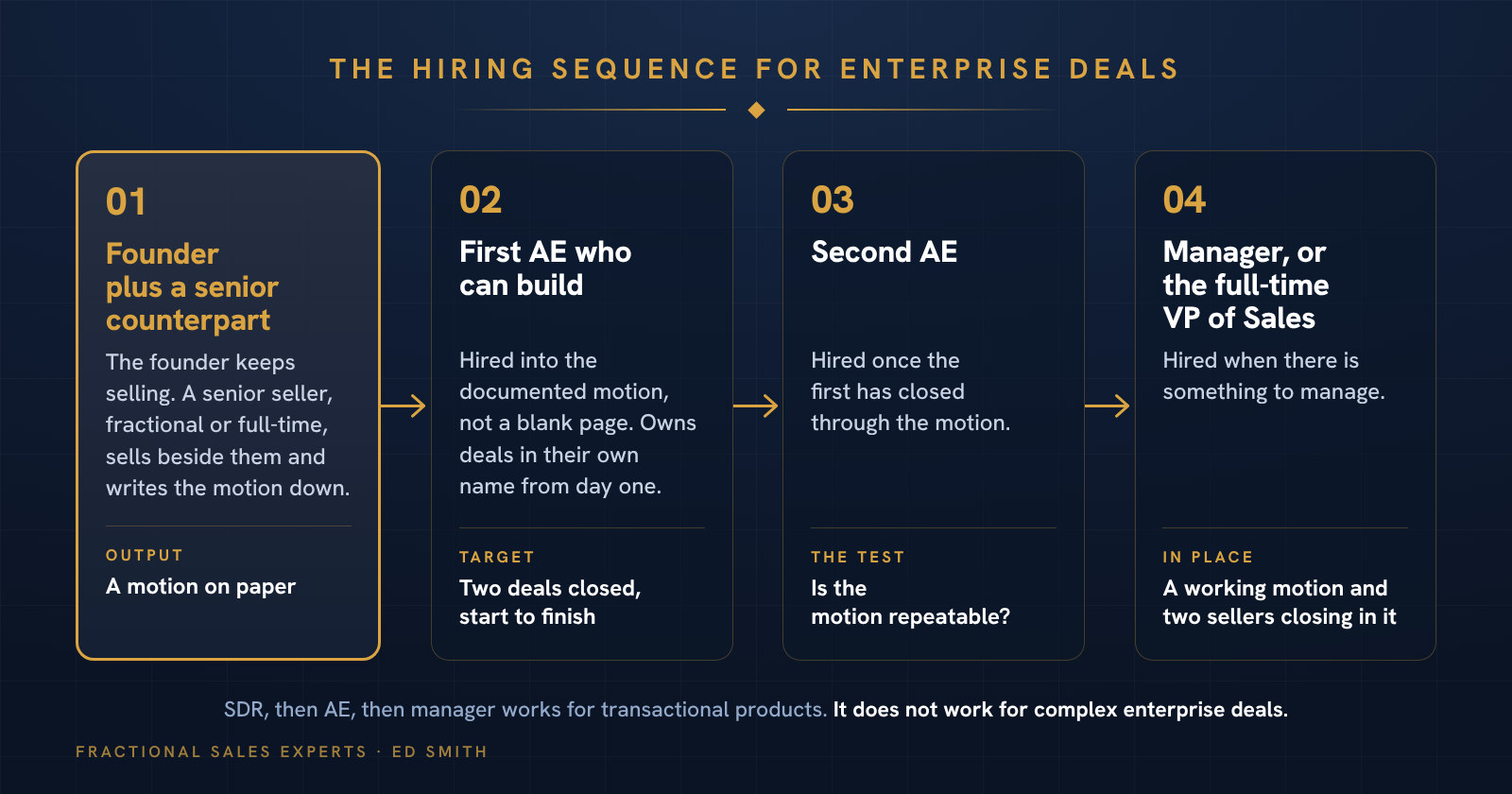
Lemkin's version of this is to get two AEs hitting quota before you hire a head of sales. I agree with the order. I would add that the two AEs need a written motion to hit quota in. Someone senior has to build it with the founder first.
For software sold into retailers, the sequence is the same but the committee is bigger and the calendar is harder. I covered the specifics in selling software into retailers.
Where a fractional VP of Sales fits
The gap in the sequence above is the senior counterpart. Most seed and Series A founders cannot justify a full-time VP salary to build a motion that does not exist yet. They should not try. That is the slot a fractional VP of Sales fills.
Sell beside the founder in live deals. Write the motion down as it really runs. Build the four things that let a team sell without the founder. Run the search and the interviews for the first AE who can build, using the questions above. Set the first comp plan in the right shape. Then hand off.
The handoff is named at the start, because an engagement with no ending is just a slower version of the early VP mistake. It ends in one of three ways: a motion that runs without me, a full-time hire I help make, or continued advisory. The engagement runs a ninety-day minimum, then thirty days' notice. Investment is scoped on the first call.
Founders sometimes ask how this differs from a fractional CRO. I wrote it up in fractional CRO vs fractional VP of Sales. The short answer is that a founder at this stage needs someone who builds and sells, not someone who reports on revenue.
What to do about it
If you are about to post a job for your first sales hire, do these first.
- Decide whether a motion exists. Write the four answers. Who buys and why now. Who else says yes, in what order. What qualified looks like. What evidence sets each stage. If you cannot write them in an afternoon, you are hiring a builder, not a runner.
- Kill the big-logo-AE job description. Rewrite it for someone who has sold without a brand, booked their own meetings and worked a committee. Put "built a motion at a company under $2M in revenue" in the requirements, and mean it.
- Do not open a VP search yet. Put a senior counterpart beside you instead, fractional or full-time. Their job is making your motion repeatable. Open the VP search when two deals have closed without you.
- Interview for building. Deals created from nothing. The full committee on their biggest deal. The pitch that failed and what they changed. A live discovery exercise against your real buyer.
- Shape comp toward base and delay the quota. Pay variable on what a builder controls in the first two quarters. Set quota once the motion has closed two or three deals and you know what a cycle looks like.
- Keep selling. The first seller sells beside you, not instead of you. Stay in the three moments and leave everything else.
If you are not sure which of these you are facing, check the fit in two minutes. It is built to tell a founder whether the problem is a missing motion or a missing person.
Questions founders ask
Should my first sales hire be a leader or a rep?
Usually neither, in the order most founders mean it. If no sales motion exists yet, the first hire should be a senior counterpart who builds it beside the founder, fractional or full-time. Then hire a first AE who can build into the documented motion, then a second AE, and only then a leader. Hire a rep into a blank page and they stall. Hire a VP to invent the motion and they build a team around a deal that does not repeat yet.
When should a startup make its first sales hire?
When the founder can write down who buys, why now, who else has to say yes, and what a qualified deal looks like. That is the sign a motion exists for someone to run. Before that, the right first move is a senior seller beside the founder who makes the motion repeatable. The trigger is committee complexity in the deals, not a specific revenue number.
Why do experienced sales reps fail at startups?
Because they are usually experienced at the last mile of a motion someone else built. At a large company they inherited a brand, inbound leads, SDRs, sales engineers and a playbook. At a seed-stage company none of that exists, and the job is to build it. Even inside working motions, Bridge Group's 2026 research puts average AE ramp at over six months; without a motion, many big-company reps never ramp at all.
Should a startup hire a VP of Sales before any reps?
No, unless the founder has already built a repeatable motion and simply needs it run and scaled. A VP hired to invent the motion usually fails and costs about a year. The safer order is founder plus a senior counterpart, then a first AE who can build, then a second AE, then the VP or manager once there are two sellers closing through a written motion.
What should I look for in a first sales hire?
Evidence that they have built, not just run. Deals they created from nothing at a company with no brand, the full buying committee named on their biggest deal, a pitch that failed and what they changed, and meetings they booked themselves. Run a live discovery exercise with you as the buyer and grade whether they ask about the trigger, the committee and the decision date before going to the demo.
How should I structure comp for a first sales hire?
Lean toward base early, with a smaller variable that pays on what a builder controls in the first two quarters: qualified opportunities against the written standard, committee maps completed, deals advanced on buyer evidence. Set quota only after the motion has closed two or three deals and you know the real cycle and deal size. Equity matters more for a builder than for a runner, because they are taking the risk that the motion does not work.
Can a fractional VP of Sales replace a first sales hire?
Not replace, but precede. A fractional VP of Sales sells beside the founder, writes the motion down, builds the qualification standard, committee map, next-step discipline and evidence-based forecast, then runs the hire of the first AE who can build. The engagement is designed to end in a motion that runs without them or a full-time hire they help make. It fits best for companies selling complex, multi-stakeholder deals, which is who I work with.
More on the work: Advisor, fractional VP of Sales and special projects · Check the fit
More notes

A Valley founder's first enterprise deal
What the first enterprise deal looks like for a Greater Phoenix founder, and what changes when your startup sales leader in Phoenix can sit in the deal review.

Your VP of Sales didn't work out. Now what?
Your VP of Sales didn't work out. Here is why it usually wasn't the person, what to do in the first two weeks, and the two moves that make it worse.