Why enterprise deals stall after the demo
If a deal dies after the demo, it is rarely because the demo was bad. It is because you never mapped who can actually say yes.
Ed Smith · 18 August 2026 · 4 min

Founders tell me the same story. The demo went well. The champion is enthusiastic. Then the deal goes quiet for three weeks and nobody can say why.
They want a process fix. A better follow-up cadence. A new sequence. Sometimes that is the work. Usually it is not.
Late-stage stalls are almost always a power-base problem. You sold to the person who liked the product. You did not sell to the people who can spend the money, absorb the risk, or kill the deal among stakeholders you never met.
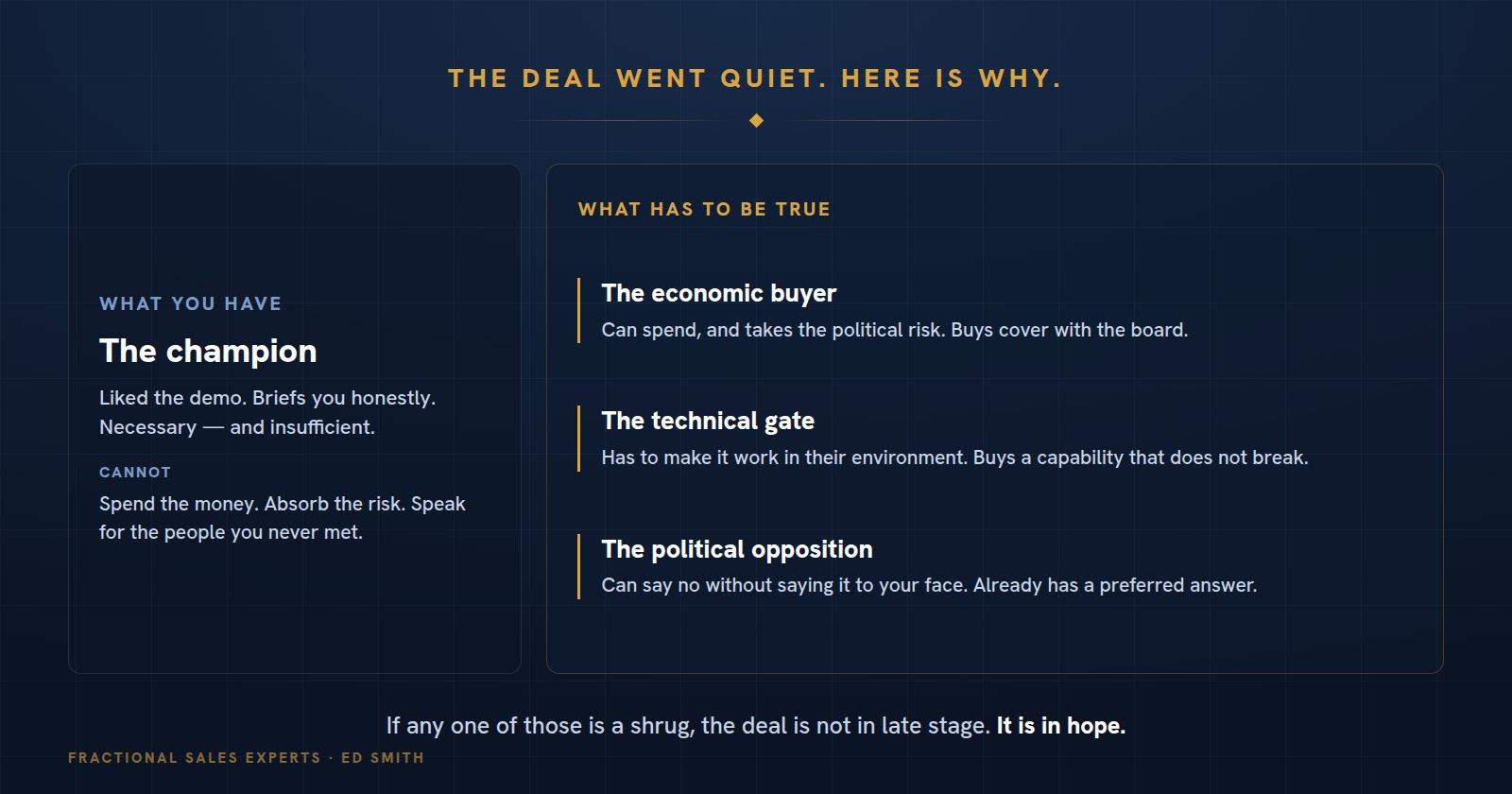
In a multi-stakeholder pursuit — C-suite, IT, procurement, a crowded AI market — the champion is necessary and insufficient. If you cannot name the economic buyer, the technical gate, and the political opposition, you do not have a forecast. You have a conversation you enjoyed.
The inspection is simple. Who has to say yes? Who can say no without saying it to your face? What does each of them actually buy — a capability, a career outcome, cover with the board? Where is the competitor already sitting, and what trap have you set for them?
That is MEDDPICC used as a knife, not a worksheet. Metrics, Economic buyer, Decision process, Decision criteria, Paper process, Implicate the pain, Champion, Competition. If any of those is a shrug, the deal is not in late stage. It is in hope.
I sit in those reviews every week. The useful question is never “how does the champion feel.” It is “who have we not yet lined up, and what happens if we never do.”
More on the work: Advisor, fractional VP of Sales and special projects · Check the fit
More notes

A Valley founder's first enterprise deal
What the first enterprise deal looks like for a Greater Phoenix founder, and what changes when your startup sales leader in Phoenix can sit in the deal review.

Your VP of Sales didn't work out. Now what?
Your VP of Sales didn't work out. Here is why it usually wasn't the person, what to do in the first two weeks, and the two moves that make it worse.