A Valley founder's first enterprise deal
What the first enterprise deal looks like for a Greater Phoenix founder, and what changes when your startup sales leader in Phoenix can sit in the deal review.
Ed Smith · 11 October 2026 · 10 min

If you're a Greater Phoenix founder selling software into a large enterprise for the first time, here is what's coming. A buying committee you've met one member of. A pilot that will try to become permanent. An InfoSec and procurement gauntlet. And an incumbent who already has the budget. I'm a fractional VP of Sales in Scottsdale, and this is what I'd want a startup sales leader in Phoenix to tell you before that first deal, not after.
The Valley's center of gravity is chips, fintech and EV. Software founders are here too.
Let me be straight about the market, because you'll know if I'm not. Greater Phoenix's economic weight sits in semiconductors, fintech and electric vehicles. That is where the big fabs, the big back offices and the big plants are. My depth is somewhere else: 30+ years selling software into retailers, brands and CPG companies. The sold-to list is on my track record page. None of it is a Valley logo, and I won't pretend otherwise.
Those two facts fit together better than they sound. Arizona has founders building exactly what I sell: software for retailers, commerce platforms, order management, AI for the store and the supply chain, analytics for brands. They're in Scottsdale, Tempe, Chandler and downtown Phoenix. And the first enterprise deal looks the same whether the buyer is a grocer or a bank.
The ecosystem around them is real and growing. GPEC reports that venture investment in Greater Phoenix grew 146% from 2014 to 2024, ahead of Austin, Atlanta and Miami over the same period. The Arizona Technology Council connects about 750 member companies. ASU's Venture Devils runs student and alumni ventures through mentorship and pitch funding. SEED SPOT in Phoenix accelerates early founders. The Center for Entrepreneurial Innovation at GateWay Community College incubates emerging-tech companies. And Arizona Tech Week drew more than 18,000 people to over 400 events in its first year.
That's a lot of pitch coaching and community. What it has less of is people who have carried a quota into a Fortune 500 buying committee for three decades. That gap is where I work. If you want the short version of what I do here, it's on the fractional VP of Sales in Phoenix and Scottsdale page.
Your first enterprise deal has six people in it. You've met one.
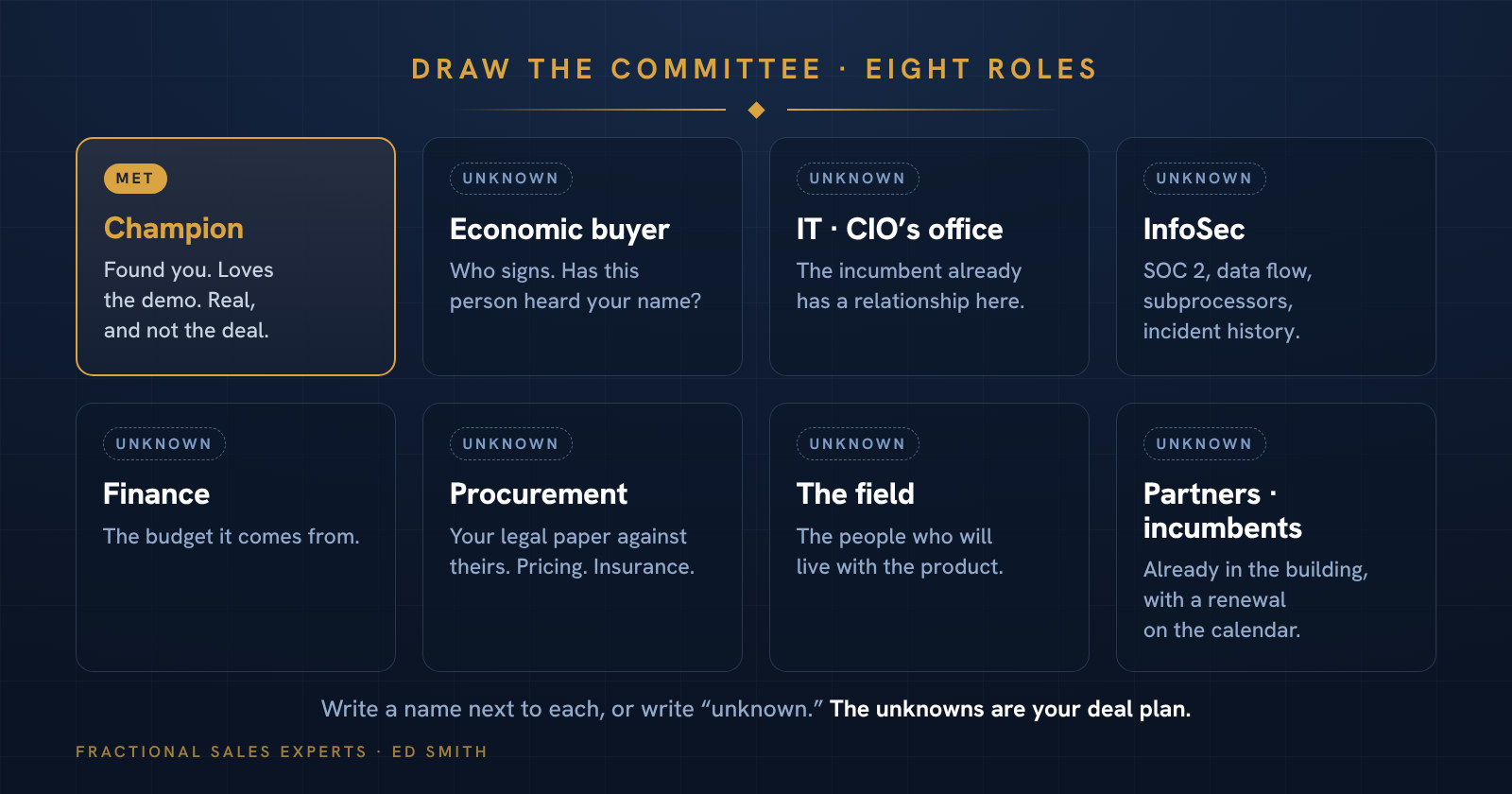
Enterprises buy through committees. A champion, the economic buyer, IT or the CIO's office, InfoSec, finance, procurement, the field who will live with the product, and the partners and incumbents already in the building. Founders sell the first person and get surprised by the other five.
Your champion is usually a director or VP who found you, loves the demo, and is personally tired of the incumbent. They are real. They are not the deal. An enthusiastic contact is not late stage if the economic buyer has never heard your name. That's hope, not a forecast.
Here is what I ask a founder in the first deal review: who signs, who can say no, and who has already met you? Most Valley founders can name the champion. Fewer can name the economic buyer. Almost none can name who in InfoSec will review them or which procurement category the deal will fall under. I go deeper on this in late-stage stalls are power-base problems.
The pilot will try to become the deal
Your first enterprise prospect will offer you a pilot. Take it, on terms. A pilot with no decision date is a science project.
A good pilot has four things written down before it starts. What success looks like, in numbers the economic buyer cares about. Who decides whether it succeeded. The date they decide. And what happens on that date if it did: the contract shape, the rollout scope, the budget it comes from.
Without those, the pilot runs, the champion is happy, and six months later you're still "in pilot" with a customer who now has your software for free. The incumbent, meanwhile, renewed. I've watched this happen to founders with great products. The product was never the problem.
InfoSec and procurement are not the last step. They are the slow step.
Founders treat security review and procurement as paperwork after the yes. In a large enterprise they are a second sale to people who have never seen your demo and don't care about it.
InfoSec will want your SOC 2 report or a plan for one, your data flow, your subprocessors, your incident history, and someone on your side who can answer in their language. Procurement will want your legal paper against theirs, your pricing structure, your insurance, and a reason not to make you wait for the next quarterly vendor review.
Start both the day the economic buyer says they want to move forward. Not the day legal asks. On a first enterprise deal, that single change usually pulls the close date in by a quarter. Also, know the enterprise's fiscal calendar. A large retailer's fiscal year often ends in January, not December, and budget that isn't committed by their Q3 is often gone.
The incumbent already has the budget
Somewhere in that enterprise is a vendor who does part of what you do, badly, and whose renewal is already on a procurement calendar. They have a relationship with IT. They have a partner manager inside the account. They've been to the holiday party.
You don't beat the incumbent by being better. Your champion already knows you're better. You beat them by giving the economic buyer a reason the status quo is now the risky choice. That is a conversation about their numbers, not your features. It is also one of the three moments the founder belongs in, and I wrote the rule for that in when the founder should show up.
The three mistakes I see Valley founders make
Mistake one: calling the champion's enthusiasm late stage. The deal goes into the forecast at 70% because the director said "this is happening." The economic buyer hasn't met you, InfoSec hasn't started, and the deal is a Q4 commit in a spreadsheet. Most early-stage forecasts are feelings with a spreadsheet around them.
Mistake two: using price as a rescue. The deal goes quiet, so the founder cuts the number to restart it. It doesn't restart, because price was never why it stopped. It stopped because power moved to someone you haven't met. Now you've trained procurement that your list price is negotiable before they've even opened the file.
Mistake three: hiring a big-logo AE to run it. The Valley has thousands of talented enterprise reps from the large employers here. Hiring one into a seed-stage company usually fails. They've run a motion with a playbook, an SDR team, and a brand that gets meetings. They've never built the motion from nothing, which is the job you actually have. Most "sales process" problems are ICP problems, and a big-logo AE will not fix your ICP.
What changes when your fractional VP of Sales can sit in the room
I work with founders across the US and Canada, and how a remote engagement runs is well tested. For Greater Phoenix founders, though, some things only happen in person. Three in particular.
The whiteboard session. The first thing I do on a real deal is draw the committee on a wall. Names, titles, who reports to whom, who has met us, who owes whom a favor, where the incumbent sits. Doing that in a room in Scottsdale or Tempe, with your champion's org chart and your founding team, takes ninety minutes. Over video it takes three calls and still has holes.
The customer meeting. When the economic buyer at a large enterprise finally takes a meeting, a founder flying solo reads as a startup. A founder with a sales leader who has sold to very large companies for 30+ years reads as a vendor. I can be in that room with you, or on the plane with you to their headquarters, and we can debrief in the car instead of on a calendar hold three days later.
The board session. Your board wants a forecast they can trust and a plan for the sales hire. I'll sit in that meeting with you, in person, and defend a forecast built on evidence instead of hope. Boards ask better questions of a sales leader than they do of a founder who is also the sales leader. It's easier for everyone.
Then there's the clock. Arizona doesn't observe daylight saving time. From November to March, Scottsdale runs two hours behind New York and one hour ahead of Pacific time. From March to November, it's three hours behind New York and level with Pacific time. Either way, an 8 AM call from Phoenix reaches a buyer in Boston or Chicago mid-morning, and a 2 PM call still catches New York before five. For a founder selling to enterprises on both coasts, a Scottsdale-based sales leader sits in the middle of everyone's day, all year.
What to do about it
If your first enterprise deal is live, or about to be, here's the order I'd work in.
- Draw the committee. Eight roles. Write a name next to each or write "unknown." The unknowns are your deal plan.
- Put a decision date on the pilot before it starts. If the customer won't give one, you don't have a pilot, you have a free trial.
- Start InfoSec and procurement the day the economic buyer leans in. Ask your champion who runs each and get an intro that week.
- Build the status-quo-is-risky case in the economic buyer's numbers. Not your ROI slide. Theirs.
- Take price off the table as a lever until the commercial conversation. If the deal stalls, find the person who stopped it. Don't discount to them.
- Decide who sells this deal: you, with a sales leader beside you, or a full-time hire you're about to make. Read when do you need a VP of Sales before you choose the third one.
If you want to know whether this is a fit before we talk, you can check the fit in two minutes or read who I work with. I'm a fractional VP of Sales in Scottsdale, I serve the whole of Greater Phoenix in person, and investment is scoped on the first call.
Questions founders ask
Do I need a startup sales leader in Phoenix, or can I run this remotely?
You can run an enterprise deal with a remote sales leader, and plenty of founders do. What you can't do remotely as well is the whiteboard session on the committee, the in-person customer meeting with the economic buyer, and the board session where the forecast gets defended. If you're in Greater Phoenix, having your fractional VP of Sales in Scottsdale means those three things happen in a room, on short notice.
What does fractional sales leadership in Phoenix actually cover?
A fractional VP of Sales owns the sales motion part-time, usually for a founder-led company between roughly $1M and $5M ARR. That means a qualification standard, a committee map on every real deal, dated and owned next steps, a forecast built on evidence, and coaching inside the live deals. The engagement is ninety days minimum with the ending named up front: a motion that runs without me, a full-time hire I help you make, or continued advisory.
Is Phoenix a good place to build an enterprise software startup?
Yes, with a clear-eyed view of what's here. Greater Phoenix venture investment grew 146% from 2014 to 2024, per GPEC. The ecosystem is strongest in semiconductors, fintech and EV, and the enterprise software and retail technology founders here are a smaller group. That means less local competition for talent and attention, and fewer local people who have sold into Fortune 500 buying committees. Plan for both.
How long does a first enterprise deal take for a startup?
Longer than your champion says. In my experience, a Series A company selling into a Fortune 500 enterprise should plan on nine to twelve months from first conversation to signed contract. The pilot, InfoSec and procurement phases are where the time goes. Starting security review and procurement early, and putting a decision date on the pilot, are the two things that shorten it.
What is enterprise sales for Phoenix startups like compared to other markets?
The deals are the same. A grocer in Ohio and a bank in New York buy through the same kind of committee. What's different in Arizona is the clock, which sits between the coasts all year, and the talent pool, which is deep in semiconductor, fintech and EV sales and thinner in enterprise software. Founders here often need to bring in the enterprise software experience rather than hire it locally.
Should I hire an enterprise AE from a big local employer for my first deal?
Usually not. A rep from a large local employer has run a motion with a brand, a playbook and an SDR team behind them. A seed or Series A company has none of that, and the job is to build it. Hiring a big-logo AE into a seed-stage company usually fails. Build the motion first, with a fractional VP of Sales or with coaching, then hire reps into something that works.
Can a fractional VP of Sales in Phoenix come to my customer meetings?
Yes. For Greater Phoenix founders, I attend the customer meetings that matter in person, including travel to the enterprise's headquarters when the economic buyer is in the room. I also sit in the deal reviews and board sessions where the forecast gets decided. The founder still belongs in three moments of every deal; I'm there so those are the only three you have to be in.
More on the work: Advisor, fractional VP of Sales and special projects · Check the fit
More notes

Your VP of Sales didn't work out. Now what?
Your VP of Sales didn't work out. Here is why it usually wasn't the person, what to do in the first two weeks, and the two moves that make it worse.

Your first sales hire: a leader or a rep?
Should your first sales hire be a leader or a rep? Usually neither, yet. The answer depends on whether a motion exists, and most founders hire before it does.