When the founder should show up — and what the fractional VP is doing
Founder and fractional VP of Sales as partners in a complex enterprise deal: three stages that need the founder, three that only feel like they do.
Ed Smith · 8 September 2026 · 7 min

In a complex enterprise deal, the founder and the fractional VP work as partners. The founder’s presence changes the stage. It lowers vendor risk. It lets the buyer hear the story from the person who will still be there in five years. It lets someone make a commitment a seller cannot make.
Used that way, it is leverage. Used as a default, it trains the buyer to wait for the founder and trains the team to stop running the deal.
The partnership is simple. The fractional VP of Sales helps you run the motion: qualification, multi-threading, power mapping, next steps, and the forecast. The founder stays in the relationships that matter. They show up when something only they can provide is required to move a deal that is already structured.
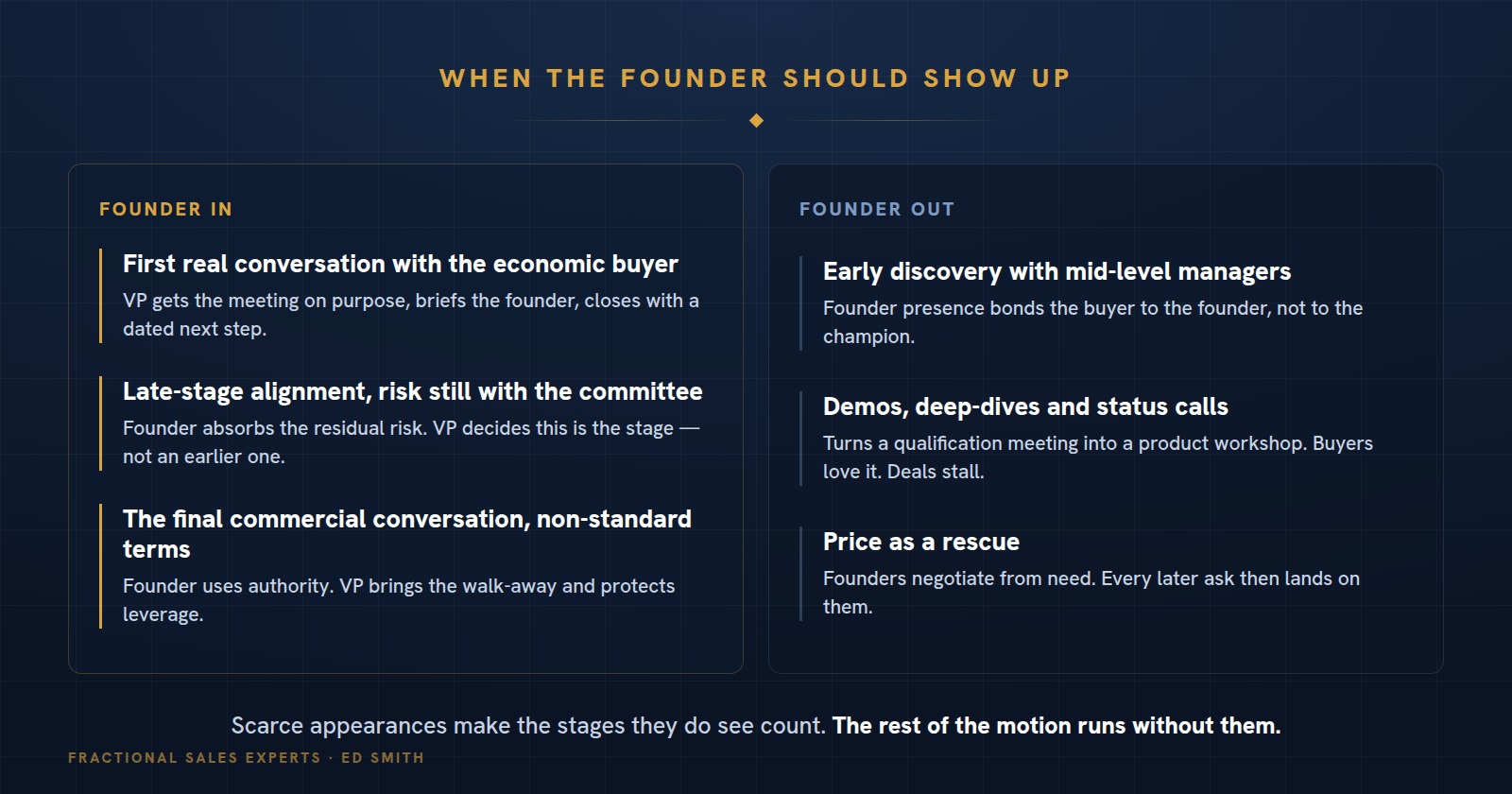
Three stages that need the founder — with the VP in the work
1. The first real conversation with the economic buyer.
Not the champion. Not the person who loves the product. The person who can spend the money and absorb the political risk — a C-level or VP-level executive on a multi-year commitment. They are buying belief in the company and the problem, not a feature list.
The founder says why the company exists, what they will and will not build, and what they will personally stand behind. The fractional VP gets that meeting on purpose, not by accident. They map who actually owns the yes, brief the founder on what that executive cares about, set the agenda, and close the call with a dated next step that does not require the founder again.
If that executive is on the first call, the founder should be there. If they appear later, match the founder to them. Do not drop the founder in as a surprise closer.
2. Late-stage alignment, when residual risk is still sitting with the committee.
Discovery and technical validation are done. The committee is forming a recommendation. Someone senior still has an unspoken veto: Will these people still exist? Can they deliver in our environment? If this goes wrong, who do I call?
The founder does not re-demo. They absorb the remaining risk, reframe the stall at the strategy level, and make live decisions on roadmap, integration, or commercial structure that a rep would have to take back to HQ. The fractional VP decides this is the stage — not an earlier one. They have already done the power map, named the veto, and written the questions the founder is there to answer. After the meeting, they convert the founder’s commitments into a mutual plan the team can run.
3. The final commercial conversation on non-standard terms.
Pricing outside the playbook. Multi-year structure. Unusual liability or security language. Board-level sign-off. First logo in a new vertical. Displacement of a major incumbent. The founder can decide in the moment. That is the point.
The fractional VP does not hand the founder a blank negotiation. They bring the walk-away, the give-gets, and the standard terms already agreed. The founder uses authority. The VP protects leverage — including the sentence founders cannot use when they sit in every commercial conversation alone: “I’ll have to take that back.”
A narrower fourth case: the deal is politically stuck and only a founder-to-founder conversation unblocks it. That is an intervention the VP calls, prepares, and debriefs. It is not a stage in the process.
Three stages the founder thinks they need — and the VP should keep them out of
Early discovery with mid-level managers.
Founders jump to product. They answer questions the buyer has not earned. They bond the buyer to themselves instead of the champion and the seller. They leave with energy and no next step that includes the economic buyer. Discovery is the motion’s job. If the founder is on every first call, you do not have a sales function. You have a founder calendar. The fractional VP runs discovery, finds the power base, and only then asks for the founder.
Demos, technical deep-dives, and status meetings.
Unless the founder is the only person who can answer a specific question that is actually blocking a decision, this is SE and seller work. Founder presence turns a qualification meeting into a product workshop. Buyers love it. Deals stall. Weekly “alignment” calls exist so the founder can feel in control. They do not close software. The VP puts the founder on the forecast review, not on the status call.
Price as a rescue.
Bringing the founder in to help on price, or to save a poorly qualified deal, is the tell that the process is broken. Founders negotiate from need. They give things away because they can. Once they are in the commercial conversation too early, every later ask lands on them. The fractional VP’s job is to refuse that use of the founder — and to fix the qualification problem instead.
The other false must: the customer asked for the founder. That is often a test of whether you have a process or a personality. If the deal is not qualified, urgency is assumed, and next steps are fuzzy, the VP keeps the founder out. Founder time is not a substitute for a champion who can sell when neither of you is on the call.
How the two of you use the stage
The fractional VP runs the meeting. They set the agenda, frame why the founder is there, time-box them, and close with a dated next step. The founder answers, commits, or reframes — then leaves. If the buyer starts treating the seller as a scheduler after that meeting, the founder was used too soon or too often.
Before any founder joins, the VP and founder ask the same five questions:
- Has the buyer named the problem in their own words?
- Has urgency been confirmed, not inferred?
- Do we know the next decision and who makes it?
- Is there something only the founder can credibly provide?
- Would this deal still move if they were unavailable this week?
If most of those are no, the founder stays out. That is the partnership working.
Enterprise deals die in stages the vendor never sees. The founder’s scarce appearances should make the stages they do see count. The fractional VP’s job is to make sure the rest of the motion can run without them — so the founder can run the company.
More on the work: Advisor, fractional VP of Sales and special projects · Check the fit
More notes

A Valley founder's first enterprise deal
What the first enterprise deal looks like for a Greater Phoenix founder, and what changes when your startup sales leader in Phoenix can sit in the deal review.

Your VP of Sales didn't work out. Now what?
Your VP of Sales didn't work out. Here is why it usually wasn't the person, what to do in the first two weeks, and the two moves that make it worse.