What a fractional VP of Sales actually does
What does a fractional VP of Sales do? He runs your sales function part-time, inside live deals, and builds the motion so you can stop being the one who sells.
Ed Smith · 23 September 2026 · 11 min

What does a fractional VP of Sales do? He runs your sales function for a fixed share of the week, inside your live deals. He builds a motion your team can run without you. He owns who you sell to, how real deals get worked, what the forecast is built on, and who does the selling. He does not carry a quota for you, and he does not replace you in the room when the room matters.
That is the short answer. The rest of this page is the Monday-to-Friday version. Most founders asking the question are really asking something else: I am still the one selling, and I need that to stop.
The job is to own the sales function, not to sell for you
A fractional VP of Sales is a sales leader, not a part-time rep. The distinction decides whether the engagement works.
A rep closes deals. A sales leader makes it possible for other people to close deals, repeatedly, without the founder in every call. That is a different job with different outputs. The founder who confuses the two ends up with an expensive bag-carrier working two days a week.
So when I say I run the function, I mean the function as it exists in a company of eleven to eighty-five people. There may be two AEs or none. There may be a pipeline in a spreadsheet. The function is still there, because deals are being worked. Someone has to own how.
I do that inside the deals that are live right now, not from a deck. Everything below is what that looks like.
Five things it owns Monday to Friday
Here is the actual work, the same list as what I help founders run. Each of these is something I own, meaning I am accountable for the answer, not just for an opinion about it.
- Who you sell to and the qualification standard. The written definition of a real opportunity, and the discipline to say no to the rest.
- The committee map and deal strategy on every real deal. Who decides, who can block, who has not heard your name yet. And what we do about each.
- The forecast. Built on evidence, dated next steps, and what the economic buyer has said, not on how a champion sounded.
- The people who sell. Hiring, coaching, managing, and when needed, exiting. Including the first AE, and the decision not to hire one yet.
- Position, price, and offer. How the product is described to a buyer, what it costs, and what the buyer is actually signing up for.
Most "sales process" problems are ICP problems. That is why the first item is first. A team selling to the wrong accounts will produce a pipeline that looks fine and converts at nothing. No amount of process fixes that, and no CRM stage definition does either.
The committee map is the second item because enterprises buy through committees. A champion, the economic buyer, IT, InfoSec, finance, procurement, the field, and the partners or incumbents already in the account. Founders sell the first person and get surprised by the other five. My job is to make sure nobody on your team is surprised.
The forecast is the third because most early-stage forecasts are feelings with a spreadsheet around them. An enthusiastic contact is not late stage if the economic buyer has never heard your name. That's hope, not a forecast. I replace hope with evidence, deal by deal, every week.
What it is not
The title gets used loosely, so it is worth being plain about what a fractional VP of Sales does not do. If a founder is buying any of these, the engagement is mislabeled.
It is not lead generation. I do not run outbound for you, buy lists, or promise meetings. I will fix the targeting so your outbound stops wasting time, and I will tell you which channel to stop funding. But filling the top of the funnel is a different service and a different vendor.
It is not an SDR team. If you need twenty dials an hour, hire for that. A sales leader who spends the week dialing is a very expensive SDR.
It is not a strategy deck. A document that describes the motion you should have is not the motion. I write things down, because a qualification standard has to be written to be enforced. But the writing is the byproduct. The deals are the work.
It is not a bag-carrier. I will be in deals, often. I will not be the person who owns the number so that you can stop thinking about it. The number stays yours, and the point of the engagement is to build the team that carries it.
Full-time VP, interim VP, sales consultant: the differences that matter
Founders usually compare three alternatives. The right comparison is not about cost. It is about what each one owns and for how long.
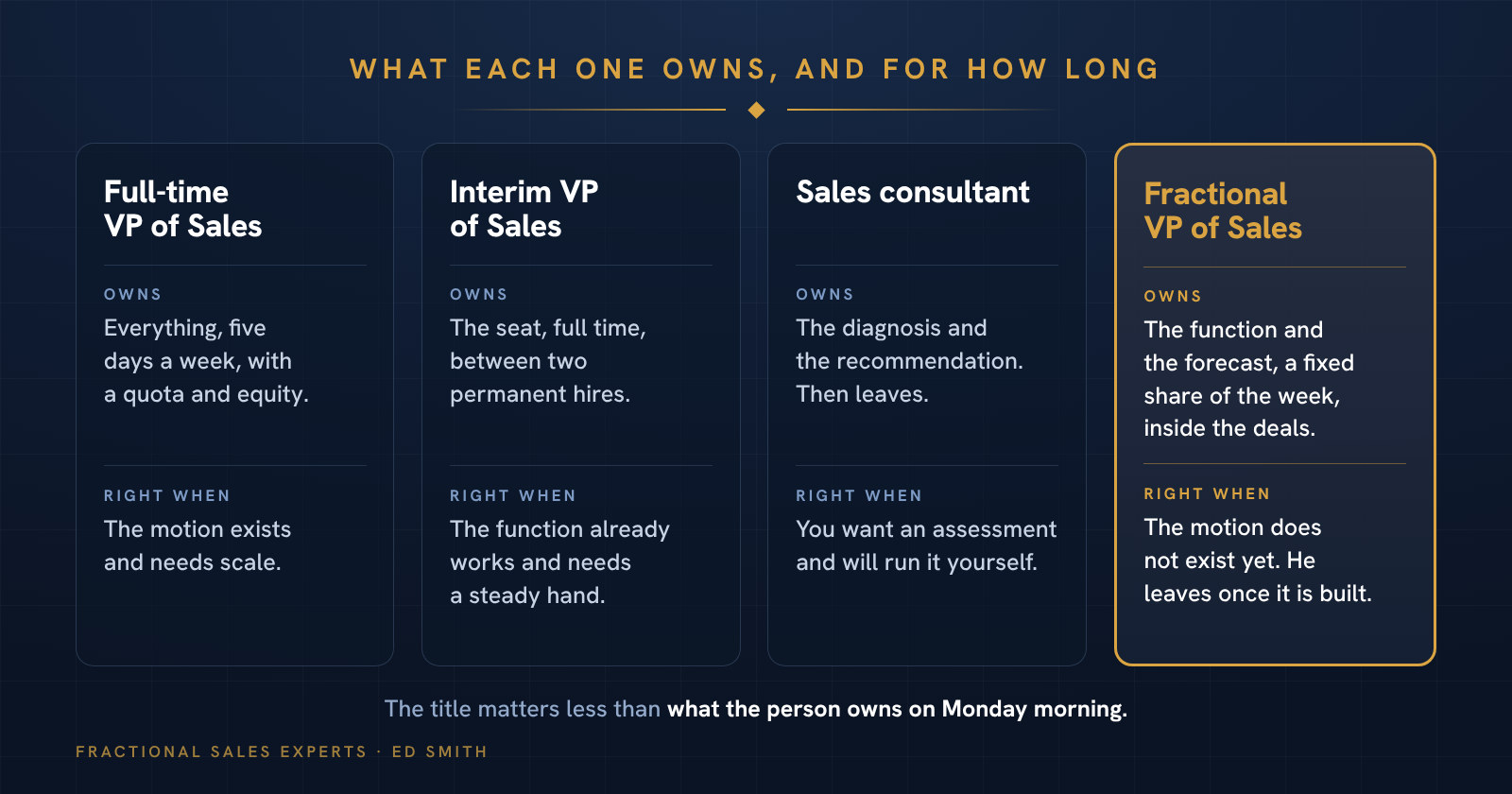
A full-time VP of Sales owns everything above, five days a week, with a quota and equity. That is the right hire when the motion exists and needs scale. It is the wrong hire when the motion does not exist yet. A full-time VP hired to invent a motion from nothing usually fails and costs the company a year. The data backs the instinct: Jason Lemkin's surveys at SaaStr put it at a startling 70% of first VP of Sales hires don't make it. Gong's analysis found average VP of Sales tenure fell from 26 months to 19 months over seven years. Nineteen months is barely enough to hire a team and run one full enterprise cycle.
An interim VP of Sales is a full-time seat-filler between two permanent hires. The role assumes the function already works and needs a steady hand while the search runs. That is a reasonable thing to buy. It is not the same as building the function.
A sales consultant diagnoses and recommends. You get an assessment, a playbook, maybe a workshop, and then the consultant leaves and you are expected to run it. The gap is accountability. A consultant is not in your Tuesday deal review and does not own the forecast you take to the board.
A fractional VP of Sales sits between those. He owns the function and the forecast like a full-time VP. He works a fixed share of the week like a consultant. He is in the deals like neither. The honest trade is this. You get a sales leader who has done it before, at a fraction of the week. In exchange, you accept that he leaves once the thing is built. I wrote more on when do you need a VP of Sales if the timing is the open question.
If you are also weighing titles, fractional CRO vs fractional VP of Sales covers that. The short version is that the title matters less than what the person actually owns on Monday morning.
The founder stays in three moments, and gets out of the rest
The founder does not disappear from selling. That is a common misread of the title, and it leads to the wrong expectation on both sides.
You belong in three moments. The first real conversation with the economic buyer, because that person is buying you and your conviction before they buy the product. Late-stage alignment, when risk still sits with the committee and the buyer needs to hear from the top that this will be supported. And the final commercial conversation on non-standard terms, because only you can trade on things a rep cannot.
You do not belong in early discovery, demos, status meetings, or in a deal as the price rescue. Every hour you spend there is an hour the motion is not being built. I keep you out of status theater and in the three moments that move power. I wrote the longer version at when the founder should show up.
Part of my job every week is naming which of those three moments a deal is in. And telling you when it is not in any of them. That is often the single most useful thing I do.
What the first ninety days produce
The engagement runs a ninety-day minimum, and I set the deliverables for those ninety days on the first call. They are the same four things in every company, because these four things are what let a team sell without the founder.
- A qualification standard, written, enforced in every pipeline review. Deals that fail it leave the forecast.
- A committee map on every real deal. Named people, their stance, what each still needs to see, and who has not been reached yet.
- Dated and owned next steps on every real deal. A pilot with no decision date is a science project. So is a "next step" with no owner.
- A forecast built on evidence. Commit, best case, and pipeline, each tied to what the buyer has actually done, not what the rep hopes.
Alongside those four, the first ninety days produce a scrubbed pipeline, usually smaller and worth more. They produce a point of view on the first sales hire, or on why that hire should wait. And they produce at least one late-stage deal worked as a committee instead of as a champion. Late-stage stalls are power-base problems, and that is where founders lose the most.
Most of my work is with companies selling software into retailers, brands, and CPG, where a nine-figure retailer's committee is the hardest version of this. If that is you, selling software into retailers has the specifics. I proved the model at Standard AI, where as VP of Sales reporting to the CEO I rebuilt the go-to-market through a product pivot. That was client zero, the engagement the practice came out of.
The ending is named at the start
A fractional engagement that does not know how it ends becomes a retainer that drifts. I name the ending on the first call, and it is one of three.
The first is a motion that runs without me. The four things above are in place, the team runs them, and I step out. The second is a full-time hire I help you make. I write the profile, run the search with you, interview, and stay through the handoff. The person who inherits the function inherits one that works. The third is continued advisory, lighter and less frequent. It is for founders who want a sales advisor at the three moments without a weekly operating role.
After the ninety-day minimum, either of us can end it with thirty days' notice. That is deliberate. A sales leader who can be let go on notice has to keep earning the seat. A founder who can leave on notice is not trapped in a bad fit.
That structure is most of the difference between a fractional VP of Sales and a retainer with a title on it.
What to do about it
If you are carrying the number and trying to decide whether this is the role you need, run this sequence.
- Write down what you think the sales function owns today, and who owns each piece. Where the answer is "me" or "nobody," that is the gap.
- Count your real deals. Apply a strict standard: a known economic buyer, a dated next step, a mapped committee. Most founders find the real number is a third of the CRM.
- Decide whether you need volume or a motion. If the motion exists and you need more of it, hire full-time. If it does not exist yet, hiring full-time to invent it is a coin flip you pay a year for.
- Pick your three moments. Then look at your calendar and count the hours you are spending outside them. That number is what a sales leader gives back to you.
- Name the ending before you sign anything. Motion that runs without them, a hire they help make, or advisory. If the person cannot say which, keep looking.
If you want a faster read on fit, check the fit in two minutes. It is the same questions I ask on a first call. I work with founders across the US and Canada, mostly remote, and with founders in Greater Phoenix in person from Scottsdale.
Questions founders ask
What does a fractional VP of Sales do?
A fractional VP of Sales owns your sales function for a fixed share of the week. That means the ICP and qualification standard, the committee map and strategy on every real deal, the forecast, the people who sell, and position, price, and offer. The work happens inside live deals, not from a deck. The goal is a motion your team can run without the founder in every call.
Does a fractional VP of Sales carry a quota?
Not in the way a rep does. A fractional VP of Sales is accountable for the forecast and for building the team that carries the number, but the number stays with the company. If someone sells you a part-time quota-carrier under this title, you are buying an expensive rep, not a sales leader.
What is the difference between a fractional VP of Sales and a sales consultant?
Accountability and presence. A sales consultant assesses, recommends, and leaves you to run it. A fractional VP of Sales owns the forecast you take to the board, runs the pipeline review, and works inside your live deals every week. One produces a document. The other produces a motion.
Will a fractional VP of Sales hire my sales team?
Yes, when the motion is ready for it. I write the profile, run the search with you, interview, and manage the person after they start. I will also tell you when not to hire yet, which is just as often the right call. Hiring a big-logo AE into a seed-stage company usually fails, and a sales leader who lets you do it is not doing the job.
How many hours a week does a fractional VP of Sales work?
A fixed share of the week, set on the first call based on how many real deals are live and whether there is a team to manage. It is enough to run the weekly pipeline review, be in the deals that matter, and own the forecast. It is not full-time, and it is not meant to be. Investment is scoped on the first call.
How long does a fractional VP of Sales engagement last?
Mine run a ninety-day minimum, then thirty days' notice either way. The ending is named at the start: a motion that runs without me, a full-time hire I help you make, or continued advisory. Most engagements run past the first ninety days, but none of them should run without an answer to how they end.
When should a founder hire a fractional VP of Sales instead of a full-time one?
When the motion does not exist yet and the founder is still head of sales. The typical window is roughly $1M to $5M ARR, but the trigger is committee complexity, not revenue. If your deals involve an economic buyer, IT, InfoSec, procurement, and an incumbent, and you are the only one who can work them, you need a sales leader before you need a sales team. See who I work with for the specifics.
More on the work: Advisor, fractional VP of Sales and special projects · Check the fit
More notes

A Valley founder's first enterprise deal
What the first enterprise deal looks like for a Greater Phoenix founder, and what changes when your startup sales leader in Phoenix can sit in the deal review.

Your VP of Sales didn't work out. Now what?
Your VP of Sales didn't work out. Here is why it usually wasn't the person, what to do in the first two weeks, and the two moves that make it worse.