Getting out of founder-led sales without losing the deals
Transitioning away from founder-led sales fails when the founder hands deals to a VP before a motion exists. Here is the sequence that keeps the deals.
Ed Smith · 2 October 2026 · 10 min

Transitioning away from founder-led sales goes wrong in one predictable way. The founder hands the deals to a new hire before there is anything to hand over, and the deals leave with the founder. The way out is a sequence, not a hire. Write down how you actually sell. Put a senior seller beside you rather than instead of you. Pull back to the three moments that need you. Then hire the full-time leader once the motion holds without you.
I have run that sequence as a fractional VP of Sales for founders of B2B software companies. I have also watched the other version fail from inside large sales organizations for 30+ years. This is what the signs look like, why the obvious fix fails, and what has to exist before anyone can take the deals from you.
Founder-led sales stops scaling quietly, and the founder is the last to notice
There is no alarm. Revenue is still growing. What changes is how the growth happens, and the signs are easy to explain away for a quarter or two.
Every serious conversation runs through one calendar. Yours. A rep books the first call, and the second call waits until you are free. Your calendar is now the sales capacity of the company.
Buyers have learned to wait for you. The champion asks for "the founder call" before they will bring in their boss. That is a compliment, and it is also a ceiling. The buyer has decided the rep cannot carry the deal, and they are usually right.
Cycles are stretching. Deals that used to close in ninety days now take five months. Nothing specific is wrong with any of them. They are waiting, and what they are waiting for is you.
And the forecast is feelings with a spreadsheet around it. Ask who the economic buyer is on each late-stage deal and when that person last heard your company's name. If the answer is "the champion says it's going well," you do not have a forecast. You have hope with columns.
Jason Lemkin's rule of thumb is that founder-led sales generally stops scaling around $1M–$2M ARR. The tell is new bookings flattening while total ARR still climbs. I would add that the revenue number is a weak signal. The real trigger is committee complexity. The day your deals need six people to say yes, one founder cannot run enough of them.
"Hire a VP of Sales to take it over" is the fix that costs a year
This is the move most founders make, and I understand why. You are tired. A VP of Sales is a person whose job is to make the tiredness stop.
Here is the problem. A full-time VP hired to invent a motion that does not exist usually fails, and the failure takes about a year to become undeniable. By Lemkin's own surveys, about 70% of first VP of Sales hires don't make it. The search alone can take six months. Add a month of onboarding, two quarters of "building pipeline," and a quarter of explanations. That is the year.
The hire fails for a structural reason, not a talent reason. A VP from a company with a working motion knows how to run a motion. They have never had to find out which three of your twelve features a retail CIO actually cares about. You know that, and it lives in your head, not in a document.
So the VP does one of two things. They run the playbook from their last company, which was built for a different buyer. Or they stand back and manage a pipeline of deals that you are still quietly closing. Either way the deals are still yours, and now there is a VP's salary and a VP's title between you and the truth.
Founders sometimes ask whether the answer is a bigger title instead. I covered that in fractional CRO vs fractional VP of Sales. The title does not change the problem. The short version of when do you need a VP of Sales is this. Hire one when there is a motion to run, not to make one appear.
Nothing can be taken over until four things exist
"Take it over" implies there is a thing. Usually there is not. There is a founder with good instincts and a CRM full of deals that only make sense to the founder.
Four things turn instinct into something another person can run. I check for all four before I let any seller carry a deal alone.
- A qualification standard. A written definition of a real deal: the buyer, the problem, the trigger, the budget owner, the decision date. Not a scorecard, a standard. A deal either meets it or it is not in the forecast.
- A committee map on every real deal. The champion, the economic buyer, IT, InfoSec, finance, procurement, the field, and the incumbents. Who has said yes, who has not been met, who can say no quietly.
- Dated and owned next steps. Every live deal has a next step with a date and a name on the buyer's side. "Following up next week" is not a next step. It is a wish.
- A forecast built on evidence. Stage is set by what the buyer has done, not by how the rep felt after the call. An enthusiastic champion whose boss has never heard your name is early stage, whatever the CRM says.
Most founders have one of these, informally. The qualification standard is in their gut, which is where most "sales process" problems actually live. They are ICP problems wearing a process costume. The committee map is in their memory. The next steps are in their inbox. The forecast is in a spreadsheet updated the night before the board meeting.
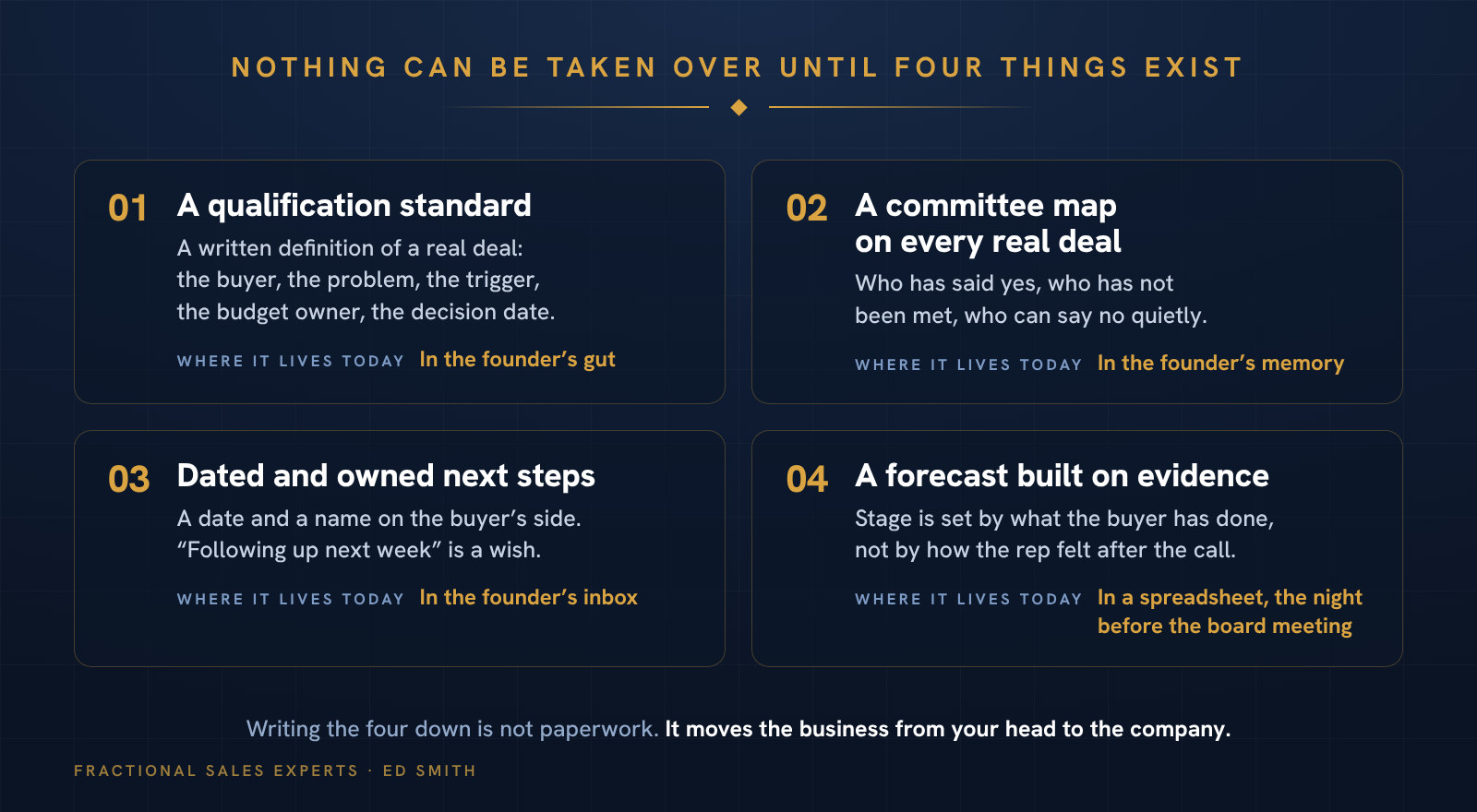
Writing the four down is not paperwork. It is the transfer of the business from your head to the company.
Step one is writing down how you actually sell, not how you think you sell
I start every transition the same way. I sit in the founder's deals for a few weeks and write down what actually happens.
What I find is never what the founder described. They say "we lead with ROI." What they do is ask the operations lead what broke last quarter, and the ROI shows up in the third meeting as confirmation. They say "the CIO is the decision maker." What they do is win the VP of Stores first and let her bring IT in.
Those real moves are the motion. A new seller cannot copy what the founder cannot describe, so the describing has to happen first.
The output is short. One page on who you sell to and the trigger that makes them buy. One page on the committee and the order you meet them in. One page on what a qualified deal looks like and what a dead one looks like. Then the talk track for the first real conversation, as it actually runs.
If you sell into retailers, this document is also where the retail-specific parts go. The fiscal calendar, the peak-season freeze, the incumbent that has to be displaced. I wrote about that in selling software into retailers.
The first seller goes beside the founder, not instead of the founder
The sequence most founders follow is: founder sells, founder stops, hire sells. That is where the deals get lost. The buyer built a relationship with you, and now a stranger is calling.
The sequence that works is: founder sells, a senior seller sells beside the founder, the founder steps back one stage at a time.
"Beside" means the seller is in every call from day one and owns the follow-up from day one. They write the committee map. They set the dated next steps. They present the forecast. You are still in the room, but the deal is in their name.
Then you leave the room in a specific order. First you drop out of status meetings and demos. Then early discovery. Then the middle of the cycle. You stay in three moments, which I will get to.
The seller has to be senior enough to build, not just run. At seed and early Series A, that means someone who has sold complex deals without a brand behind them. Someone who was there before the playbook existed. A big-logo AE who inherited a motion, a brand and an SDR team usually fails here. They are not bad sellers. They have never had to do the first part.
This is the role I play as a fractional VP of Sales. I am the senior counterpart beside the founder while the four things get built. Then I run the hire of the person who will own it next. The shape of that work is in what I help founders run.
The founder retreats to three moments, not to zero
The goal is not a founder who never sells. It is a founder who sells in the three places where only the founder's weight moves the deal.
The first real conversation with the economic buyer. Not the champion. The person who owns the budget and the problem. They want to meet the person who built the thing, once, early. Give them that.
Late-stage alignment while the risk still sits with the committee. This is where deals stall, and they stall because the power base was never built, not because the price is wrong. I wrote about that in late-stage stalls are power-base problems. A founder in the room, saying what the company will commit to, moves risk off the committee.
The final commercial conversation on non-standard terms. When procurement wants something the contract does not say, the founder is the only one who can say yes with authority.
That is the list. Not early discovery. Not demos. Not the weekly status call. Not price as a rescue when a deal is slipping. The full argument is in when the founder should show up.
Three moments per deal is sustainable at twenty live deals. Every meeting on every deal is not sustainable at five.
Hire the full-time leader when the motion holds without you
There is a clean test for whether the motion exists. A seller who is not you has taken a deal from first conversation to signature, through the committee. You were present only in the three moments. Then a second seller has done it.
Before that, you do not have a motion. You have a founder with help.
First Round's Meka Asonye puts the floor for a first dedicated sales hire at 10 customers, and probably closer to 25 for B2B companies. I would put it differently. The count matters less than whether someone other than you has closed one of them.
Once it holds, hiring a VP of Sales is a different and much safer decision. The job description is real: run this, grow this, hire into this. Candidates can be tested against it. A VP who inherits a documented motion with two sellers closing in it has a job they have done before.
I run that hire for the founders I work with. The engagement is designed to end, and the ending is named at the start. A motion that runs without me, a full-time hire I help make, or continued advisory. The whole point of the sequence is that the handoff is to a working thing, not to a hope.
What the founder keeps forever
One part of founder-led sales should never transition. The relationship with the economic buyer at the top of your biggest accounts.
The CIO of your largest retailer, the COO at your anchor customer, the executive who took a chance on you at version one. Those relationships are company assets, and they are held by you. A VP of Sales will manage the accounts. You keep the executive.
In practice that is a few conversations a quarter. A call before renewal. A visit when something changes on their side. A note when you ship the thing they asked for. It is the cheapest and highest-return selling you will ever do, and no one else can do it for you.
Everything else should leave your calendar: the pipeline, the committee work, the forecast, the first forty conversations a quarter. The top of the biggest accounts stays.
What to do about it
Here is the order I would run it in, starting Monday.
- Test the forecast for evidence. For every deal past stage two, name the economic buyer and the date they last heard from you. Move anything without an answer back to early stage. That is your real pipeline.
- Write the four things down. Qualification standard, committee map, dated next steps, evidence-based stages. One page each. If you cannot write one, that is the gap a new hire would fall into.
- Put a senior seller beside you before you hire a VP. Fractional or full-time, the person has to have built a motion somewhere without a brand behind them. They own the deals in name from day one, with you in the room.
- Leave the room in order. Status meetings and demos first, then early discovery, then the middle. Keep the three moments. Tell your team which three so they stop booking you for the rest.
- Set the test for the full-time hire. Two deals closed start to finish by someone who is not you, with you in only three moments. Do not open the VP search until that has happened.
- Keep the top of the biggest accounts. List the five executives who matter most and put a quarterly conversation with each on your calendar now.
If you want a second opinion on where you are in this sequence, check the fit in two minutes. It will tell you whether the problem is a motion that does not exist yet, or a motion that needs a different person running it.
Questions founders ask
How do I transition away from founder-led sales without losing deals?
Keep the founder in the deals while a senior seller takes ownership of them, then step back one stage at a time. Document how you actually sell first, so the seller is copying a real motion and not guessing. Stay in three moments: the first economic-buyer conversation, late-stage alignment, and the final commercial terms. Hire a full-time VP of Sales only after someone other than you has closed deals start to finish.
Why is my founder-led sales not scaling?
Because the founder's calendar is the company's sales capacity, and a calendar does not scale. The signs are a second call that waits for the founder, buyers who ask for "the founder call" before involving their boss, cycles that stretch for no specific reason, and a forecast built on champion enthusiasm. Underneath, there is usually no written qualification standard and no committee map, so nobody else can run a deal the way you do.
When should a founder stop doing sales?
A founder should never stop entirely. They should stop doing early discovery, demos, status meetings, and price negotiations as a rescue. They should keep three moments on every significant deal and keep the executive relationship at the top of the biggest accounts for good. The time to start stepping back is when deals need a committee to say yes, not when a revenue number is hit.
Should I hire a VP of Sales to take over founder-led sales?
Not until a motion exists for them to take over. A VP hired to invent the motion usually fails and costs about a year, including the search. Put a senior seller beside you first, fractional or full-time, build the qualification standard, committee map, dated next steps and evidence-based forecast, and get two deals closed without you. Then hire the VP into a job that is real.
What should a founder keep doing in sales after hiring a sales team?
Three things per deal and one thing forever. Per deal: the first real conversation with the economic buyer, late-stage alignment while risk still sits with the committee, and the final conversation on non-standard terms. Forever: the executive relationship at the top of your biggest accounts. Everything else belongs to the team.
How long does it take to transition away from founder-led sales?
Long enough for someone other than you to close two complex deals start to finish, which depends on your sales cycle. For a company with four-to-six-month enterprise cycles, that usually means two to three quarters from the day a senior seller joins you in the deals. It takes longer if you skip the documentation step, because the seller spends the first quarter reverse-engineering what you do.
Is a fractional VP of Sales a good way to get out of founder-led sales?
It is the way I do it, so I am biased, but the logic holds. A fractional VP of Sales is the senior counterpart who sells beside you, builds the four things, and runs the hire of the full-time leader when the motion holds. The engagement has a named ending, so you are not paying a VP's salary while the motion gets invented. It fits best for companies selling complex, multi-stakeholder deals, which is who I work with.
More on the work: Advisor, fractional VP of Sales and special projects · Check the fit
More notes

A Valley founder's first enterprise deal
What the first enterprise deal looks like for a Greater Phoenix founder, and what changes when your startup sales leader in Phoenix can sit in the deal review.

Your VP of Sales didn't work out. Now what?
Your VP of Sales didn't work out. Here is why it usually wasn't the person, what to do in the first two weeks, and the two moves that make it worse.