Does a fractional VP of Sales actually work?
Is a fractional VP of Sales worth it? Jason Lemkin says almost never. Here is when he is right, when he is wrong, and five questions to tell which one you are.
Ed Smith · 26 September 2026 · 11 min

Does a fractional VP of Sales actually work? Sometimes, and the cases are predictable. It fails when a founder hires someone to carry a bag part-time, when the motion needs full-time volume, or when the fractional treats it as consulting. It works when the motion does not exist yet and the founder is still head of sales. It works when the deals are committee deals and the fractional is inside them, with a named ending. So is a fractional VP of Sales worth it? That depends on which of those two situations you are in, and you can tell in advance.
I run a fractional VP of Sales practice, so I have an interest here. That is exactly why I want to take the strongest argument against it seriously, rather than wave it off.
Lemkin's argument, stated fairly
Jason Lemkin at SaaStr has written that a fractional VP of Sales almost never works. His post is worth reading in full: A Fractional VP of Sales Almost Never Works. Avoid Them. Here's Why. His line on it is blunt: "It's almost always a waste of time, money and energy."
His reasoning runs in four parts. First, early-stage sales needs full commitment, and a fractional leader focused on process cannot fix a product nobody has heard of. Second, fractional leaders rarely recruit and build a team, which is most of what a VP of Sales is for. Third, many of them mostly give advice, and a founder can only absorb so much advice. Fourth, hiring one before you understand your own motion creates false progress. You feel productive without being productive.
His recommendation is that the founder sells, or hires one or two strong reps, until roughly $1M to $2M ARR. Then hire a full-time head of sales to scale it.
He allows one exception. A fractional who is hands-on, truly good, and committed to helping hire the full-time VP, with the network to deliver.
I think that is a fair description of a large share of the market. I also think it describes a specific kind of fractional, hired for a specific reason, and that the exception he allows is not an exception. It is the job.
Where he is right
Three situations produce the failures Lemkin is describing. I have seen each one up close, and I turn down engagements that look like them.
The part-time bag-carrier. A founder is tired of selling and hires a fractional to close deals for him two days a week. This fails almost every time. A sales leader who spends his hours as a rep is an expensive rep. A rep who is only there two days a week loses to the competitor's full-time rep. Worse, the founder has now left the deals that still need him in them. Nothing was built. The founder just paid to be absent.
A motion that needs volume. If your product sells in a thirty-day cycle to one buyer for a four-figure contract, you need throughput. You need reps making calls, a manager making sure they do, and a full-time leader keeping the machine fed. A fractional cannot supply volume and should not pretend to. Lemkin's advice is right here: hire reps, sell yourself, and get a full-time head of sales when it is time to scale.
The fractional who treats it as consulting. This is the most common failure and the hardest to spot in advance. The fractional shows up, runs an assessment, delivers a playbook, holds a weekly call to give advice, and is never inside a live deal. The founder gets a document and a bill. Lemkin calls this advice overload and false progress, and he is right. A sales leader who is not in your Tuesday pipeline review, owning the forecast, is not leading sales. He is commenting on it.
If any of those three describes what you are about to buy, do not buy it. It will not work, and the title on the invoice will not change that.
Where it works
Now the other side. Four conditions, and I want all four before I take an engagement.
The motion does not exist yet. Lemkin's own data is the strongest argument for this one. By his surveys, a startling 70% of first VP of Sales hires don't make it. Most of those failures are not bad people. They are good people hired to scale a motion that was never defined. Nobody can invent a motion and scale it at the same time. Founders hire a VP of Sales too early to avoid selling themselves, and it costs a year. A fractional whose explicit job is to build the motion, then hand it to the full-time hire, keeps you out of that 70%. See when do you need a VP of Sales for the timing.
The founder is still head of sales. This is the condition Lemkin and I agree on most, and it is the one founders resist. The fractional does not replace you. He works on the premise that you are head of sales. His job is to make that stop being true, deliberately, over the next two or three quarters. If you want to be gone from selling next month, this is not the tool.
The deals are committee deals. A fractional earns his seat on complexity, not on volume. If your buyer is an enterprise, you are selling to a champion, the economic buyer, IT, InfoSec, finance, procurement, the field, and an incumbent. Founders sell the first person and get surprised by the other five. A sales leader who has run that committee a few hundred times can change the outcome of a deal that is live right now. That is a different value than process advice, and it is why the trigger for this role is committee complexity, not ARR.
The fractional works inside live deals and names the ending. This is Lemkin's exception, and it should be the definition. The fractional is in the deal review every week. He owns the forecast. He builds the committee map on every real deal and holds the team to dated next steps. And on the first call, he says how it ends: a motion that runs without him, a full-time hire he helps make, or continued advisory. If he cannot say which, he is a consultant with a better title.
Those four conditions describe most of the founders in who I work with. They sell software to large companies, usually retailers, brands, or CPG. They are between roughly $1M and $5M ARR. They are still in every deal. And the deals that stall, stall late, in front of a committee, which is where late-stage stalls are power-base problems and not process problems.
The founder stays in three moments, and that is the point
The reason the bag-carrier model fails is that it removes the founder from the wrong places. The reason the model I run works is that it removes the founder from the right ones.
You belong in three moments. The first real conversation with the economic buyer. Late-stage alignment, when risk still sits with the committee and they need to hear from the top. And the final commercial conversation on non-standard terms. In those three, nobody can substitute for you, fractional or full-time.
You do not belong in early discovery, demos, status meetings, or in a deal as the price rescue. Every hour there is an hour the motion is not being built. The fractional's job is to get you out of those hours and keep you in the three that matter. I wrote the full version at when the founder should show up.
Measured that way, "does it work" has a concrete test. After ninety days, is the founder spending fewer hours outside the three moments, and are the deals he left still moving? If yes, it is working. If no, it is not, and no amount of advice makes up for it.
Where I proved it
I did not start with the theory. The practice came out of one engagement, which I call client zero.
At Standard AI, I was VP of Sales reporting to the CEO through a product pivot. The old motion did not survive the pivot, so I rebuilt the go-to-market from the ICP up. Who we sold to. How the committee at a large retailer actually decided. What the forecast was allowed to contain, and who was in which conversation. That work influenced more than $5M in pipeline. It is also where the four things that let a team sell without the founder got written down. A qualification standard. A committee map on every real deal. Dated and owned next steps. A forecast built on evidence.
That is the model I run now, across founders in the US and Canada. The rest of the 30+ years, selling enterprise software into retailers for companies you have heard of, is on the track record page. It matters here for one reason: the committee at a nine-figure retailer does not care whether your sales leader is full-time. It cares whether he has been in that room before.
Five questions to tell whether a fractional VP of Sales will work for you
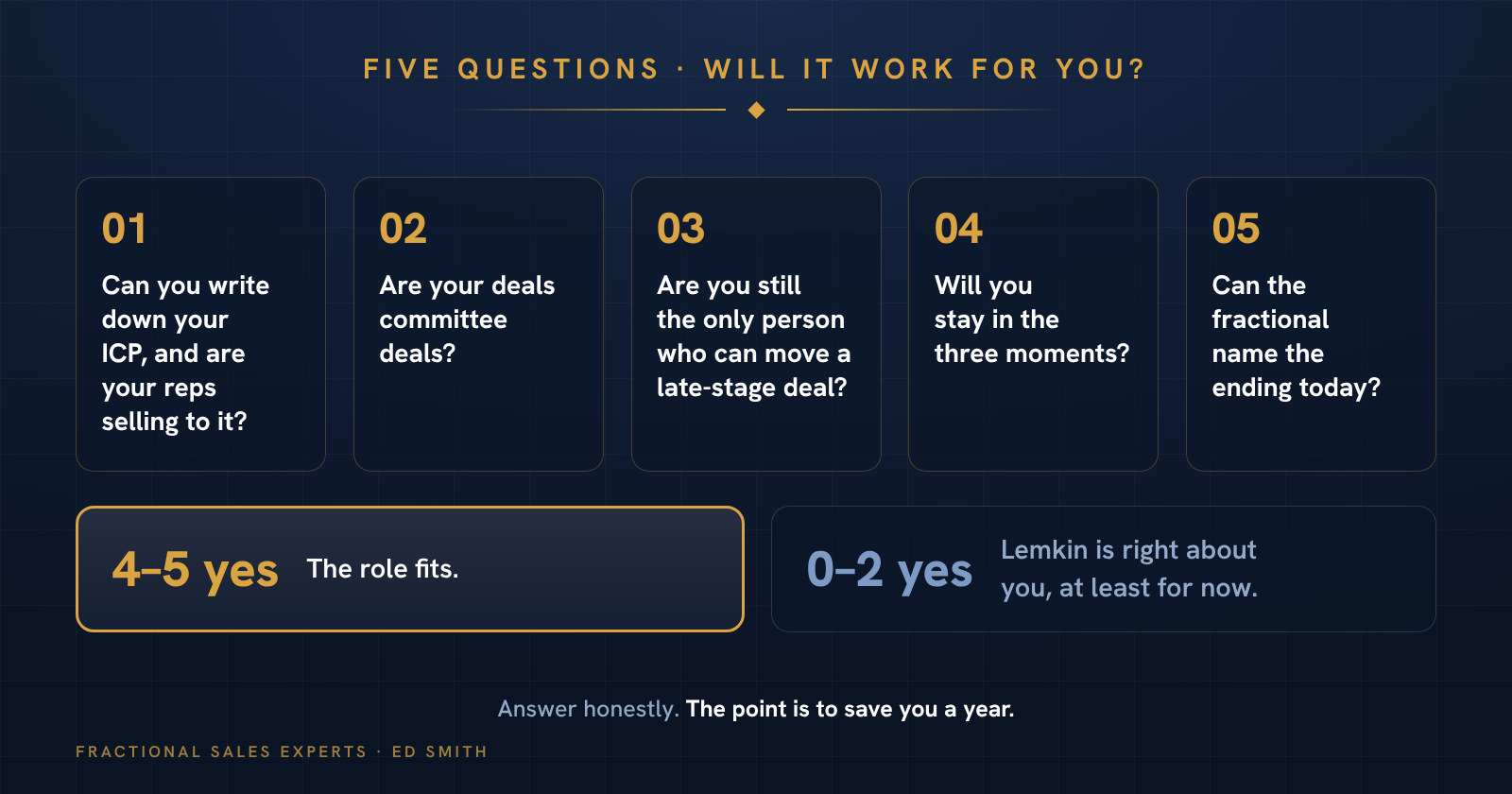
Here is the test. Answer honestly, because the point is to save you a year, not to sell you an engagement.
- Do you know your ICP well enough to write it down, and are your reps selling to it? If your reps are off-target, a fractional can fix that. If you have no idea who buys and why, you need more founder selling first, not a sales leader.
- Are your deals committee deals? If a single buyer can sign in thirty days, you need volume and a full-time leader. If six people and an incumbent decide, you need someone who has run that committee.
- Are you still the only person who can move a late-stage deal? If yes, a fractional inside those deals changes the outcome now. If your team can already do it, you are past this stage. Hire full-time.
- Will you stay in the three moments? If you want to be out of selling entirely next quarter, no fractional can make that true without losing deals. Stay in the three moments and leave the rest, and it works.
- Can the fractional name the ending today? Ask on the first call. A motion that runs without him, a full-time hire he helps make, or advisory. If the answer is vague, the engagement will be too.
Four or five yeses, and the role fits. Two or fewer, and Lemkin is right about you, at least for now. Either answer is useful. If you want the two-minute version, check the fit in two minutes.
What to do about it
- Count the real deals in your pipeline. A real deal has a known economic buyer, a dated next step, and a mapped committee. The number is usually a third of what the CRM says, and that number decides whether you need volume or a motion.
- Write down the three moments you will stay in, and count the hours you spend outside them. That is the time a sales leader returns to you. If the number is small, you do not need one yet.
- If you decide on full-time, hire for the motion you have, not the one you want. Gong's analysis put average VP of Sales tenure at 19 months, down from 26. A VP hired to invent a motion from nothing rarely gets that long.
- If you decide on fractional, buy a sales leader, not a rep and not a playbook. Ask whether he will be in the weekly deal review, own the forecast, and build the committee map on every real deal. Ask how it ends.
- Set a ninety-day checkpoint with two questions. Is the founder spending fewer hours outside the three moments? Are the deals the founder left still moving? If either answer is no, stop.
- Keep the first-call conversation about fit, not fees. Investment is scoped on the first call once we both know whether the role fits. Most of my engagements run remote; how a remote engagement runs covers the mechanics.
Questions founders ask
Is a fractional VP of Sales worth it?
It is worth it when the motion does not exist yet, the founder is still head of sales, the deals are committee deals, and the fractional works inside live deals with a named ending. It is not worth it when you need a part-time closer, when your motion needs full-time volume, or when the fractional treats the work as consulting. The test is whether, after ninety days, the founder is spending fewer hours outside the three moments and the deals are still moving.
Does a fractional VP of Sales actually work?
Yes, under four conditions, and no outside them. It works when the sales motion still needs to be built, the founder is still the one selling, the buyer is a committee, and the fractional owns the forecast and works inside live deals. It fails as a part-time bag-carrier, as a substitute for volume, or as advice without accountability.
Why does Jason Lemkin say a fractional VP of Sales almost never works?
His argument is that early-stage sales needs full commitment, fractionals rarely build teams, advice is not the bottleneck, and hiring one before you understand your motion creates false progress. He recommends the founder sell until roughly $1M to $2M ARR, then hire full-time. He allows one exception: a hands-on fractional committed to helping make the full-time hire. I think that exception is the job description, and the rest of his critique describes fractionals hired for the wrong reason.
What ARR do you need before a fractional VP of Sales makes sense?
The typical window is roughly $1M to $5M ARR, but the trigger is committee complexity, not revenue. A company at $800K ARR selling to a Fortune 500 retailer through six stakeholders needs a sales leader more than a company at $3M selling one-call deals. Below the window, with no committee, the founder should keep selling.
Should I hire a fractional VP of Sales or sales reps first?
If you cannot write down your ICP and qualification standard, hire neither yet and keep selling. If you can, and your deals are committee deals, a fractional VP of Sales before the first rep means the rep inherits a motion instead of inventing one. Hiring a big-logo AE into a seed-stage company with no motion usually fails, and so does the first VP hired to do the same.
How do I know if a fractional VP of Sales is working?
Two measures at ninety days. The founder is spending fewer hours outside the three moments, and the deals the founder stepped back from are still moving on dated, owned next steps. Secondary signs: the pipeline is smaller and worth more, every real deal has a committee map, and the forecast you take to the board is built on evidence rather than enthusiasm.
What should a fractional VP of Sales do in the first 90 days?
Four things. Write and enforce a qualification standard. Build a committee map on every real deal. Put dated, owned next steps on every real deal, and remove the ones that have none. Rebuild the forecast on evidence. Alongside those, he should have been in the room on at least one late-stage deal and have a written view on whether and when to make the first sales hire.
More on the work: Advisor, fractional VP of Sales and special projects · Check the fit
More notes

A Valley founder's first enterprise deal
What the first enterprise deal looks like for a Greater Phoenix founder, and what changes when your startup sales leader in Phoenix can sit in the deal review.

Your VP of Sales didn't work out. Now what?
Your VP of Sales didn't work out. Here is why it usually wasn't the person, what to do in the first two weeks, and the two moves that make it worse.