Six titles, one job: choosing a fractional VP of Sales
The title sets the commitment. It doesn't tell you who can do the work.
Founders hire me under six different titles. The work underneath is the same. Here is what that work is, how to tell which version you need, and what to ask anyone you're considering, me included.
Based in Scottsdale, Arizona. In person across Greater Phoenix, remote with founders across the US.
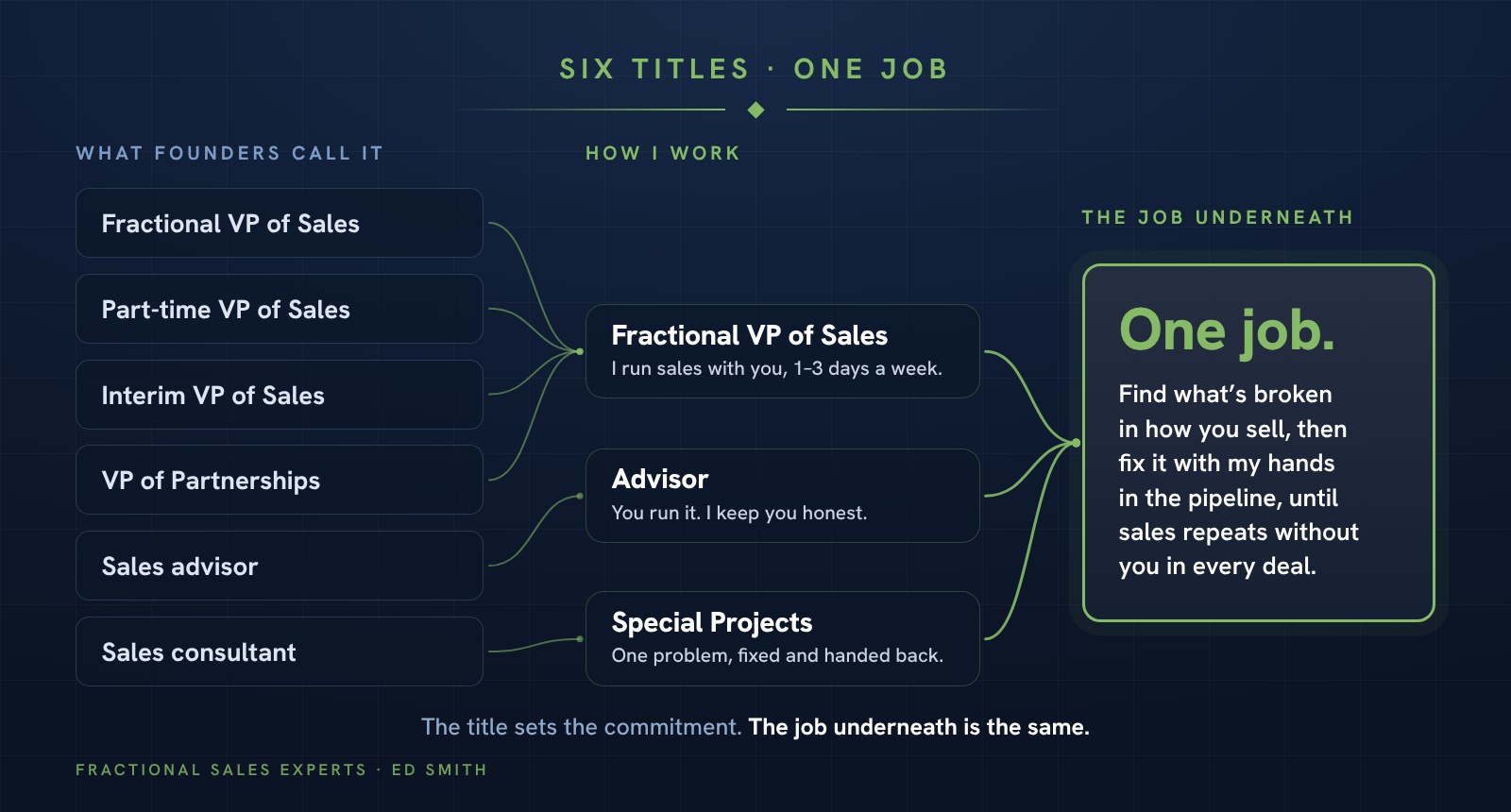
What founders call it, and what they mean.
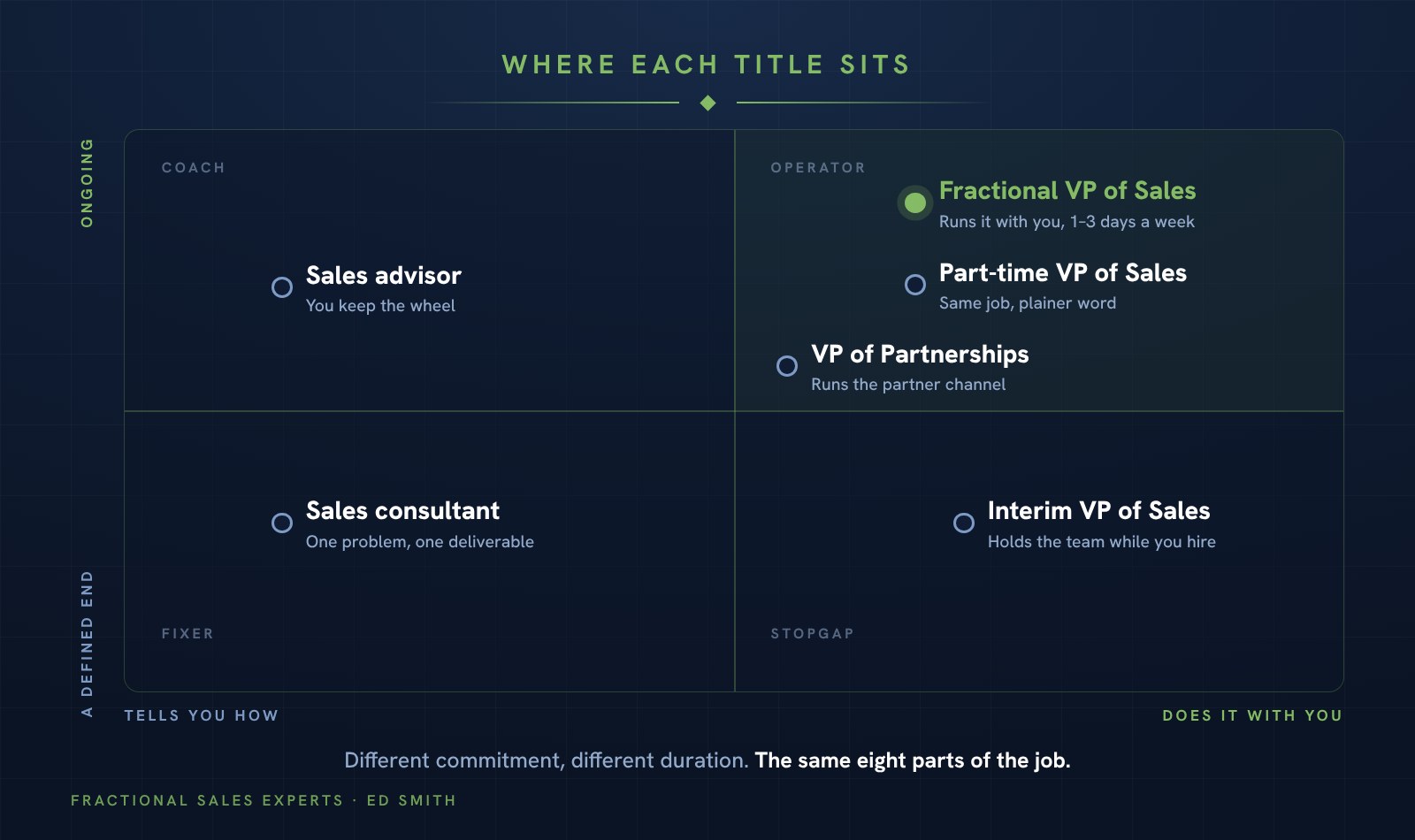
These are the six labels founders have actually used with me. What changes between them is how hands-on the work is and how long it lasts. The work itself doesn't change.
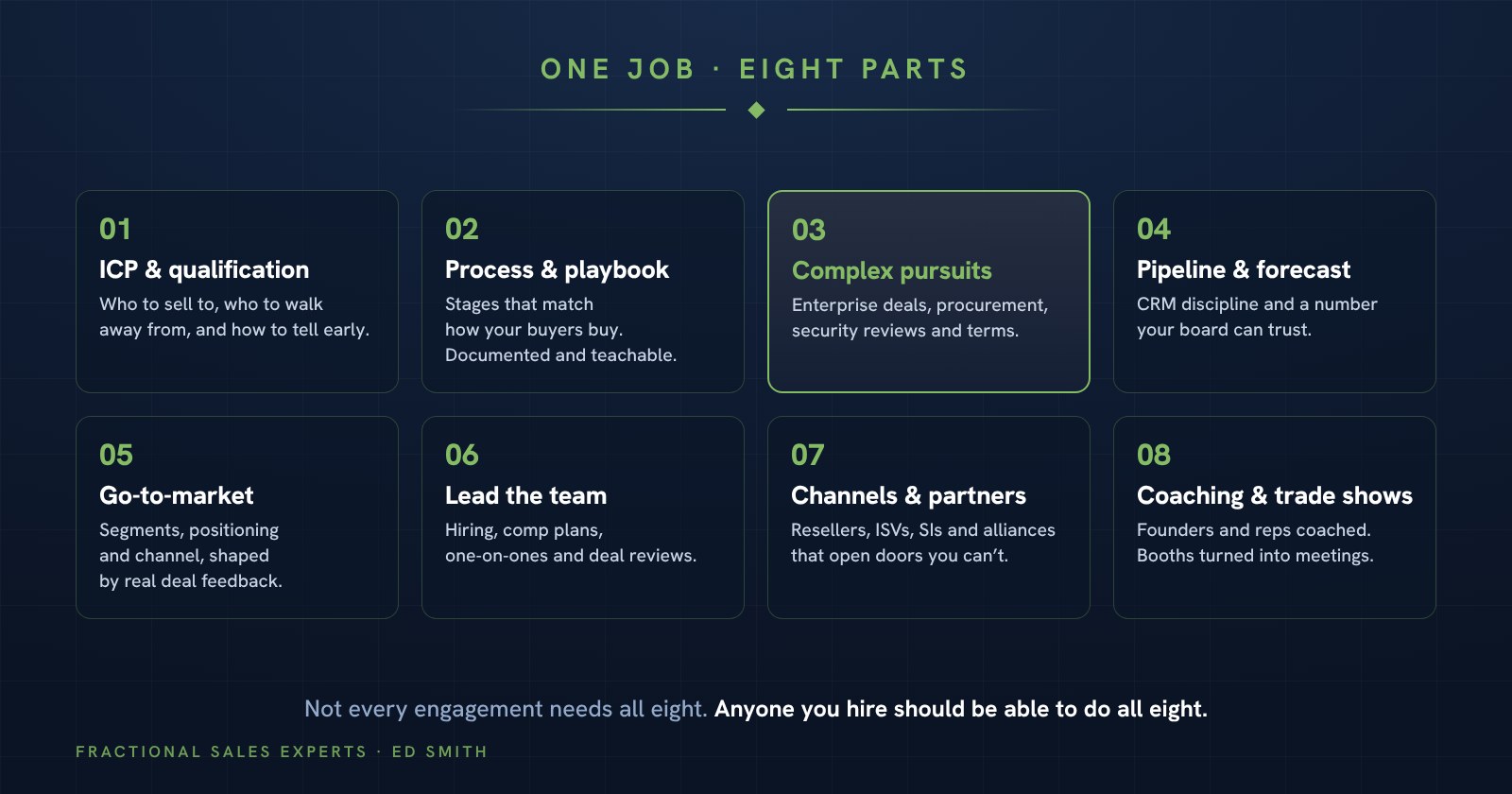
Whatever the title, this is the work.
Not every engagement touches all eight. Which ones matter depends on what's broken. But anyone you hire at this level should be able to work in all of them.
ICP and qualification
Who to sell to, who to walk away from, and how to tell early. Most “sales process” problems are ICP problems. We define who actually buys, write the qualification criteria down and run every open deal through them. It is usually an uncomfortable afternoon, and the highest-return one of the engagement.
Sales process and playbook
Stages that match how your buyers actually buy. Documented and teachable. Buyers don't fail your sales process. Your sales process fails their buying process. We rebuild the stages around the decisions your buyer is really making, with exit criteria, so a stage means something happened rather than something was felt.
Complex pursuits
Enterprise deals, procurement, security reviews, pricing and terms. The part founders have no map for: the economic buyer, a committee where four people can say no and one can say yes, security questionnaires, legal and non-standard terms. I run them with you or for you. Why deals die here.
Pipeline and forecast
CRM discipline and a forecast you, and your board, can trust. Most early-stage forecasts are feelings with a spreadsheet around them. We put in the hygiene, the deal reviews and an evidence standard that makes the number defensible, then run the rhythm until it holds without me.
Go-to-market
Positioning, segments, channel and pricing, shaped by real deal feedback. Not a strategy deck. The segments you can actually win, the motion that fits your deal size, and packaging corrected by what buyers said out loud in your last ten deals.
Lead and manage the team
Hiring, comp plans, one-on-ones and deal reviews. I can run the team for you. Job specs, interview loops and the hiring sequence, in the right order. Coaching reps and first-time managers through live deals, and telling you plainly who isn't going to make it.
Channels and partners
Resellers, ISVs, SIs and alliances that bring you deals you couldn't reach alone. I've built partner ecosystems and co-sold through them. Who to partner with, what the deal looks like on both sides, how to get their sellers to carry you, and how to tell a real partnership from a logo swap.
Coaching and trade shows
Coaching founders and reps, plus show plans that turn booths into meetings. I've worked 26 years of NRF. A show plan defines your ICP for the floor and gives every person on your team a day-by-day plan. On site I direct the right people into the booth so your team can position and get back out.
Three more things founders bring me.
Special Projects
Work that doesn't need a retainer: sales-side due diligence on an acquisition, US market entry, a sales tech stack you've outgrown, or the search for your full-time VP of Sales. Scoped, done and handed back.
The investor and board story
Turning sales performance into a story a board will fund: pipeline quality, forecast accuracy, and what the next hire buys you. Most useful six to twelve months before a raise.
Founder-led sales, done deliberately
When you should be in the room and when you shouldn't. A few moments in a complex deal need the founder; most don't. When the founder should show up.
Eight questions to ask on the first call.
Ask them of anyone you're considering, me included. The answers tell you more than the title does.
Walk me through a deal you personally closed at my deal size, in my kind of sale.
Not a company they worked at. A deal. If the answer stays at the strategy level, they have run teams but not carried a number lately, or they have only sold at a size that doesn't translate.
What will you have done by day 30, and what will I be able to see?
A good answer is specific: the pipeline reviewed against real criteria, your last ten deals taken apart, the stages rewritten, and two or three things you can stop doing. If the answer is “discovery and alignment,” ask what you will have in your hands.
Are you going to run it, or tell me how to run it?
Both are legitimate. Confusing them is how engagements go wrong. Make them say it out loud, and check the answer matches what you need.
How many hours a week, on which days, and how many other clients?
Fractional means a fraction, and the honest version of that is a schedule. Vagueness here usually means you would be one client too many.
What's the first thing you'd expect me to fire you for?
Anyone who has operated has an answer. It tells you how they think about accountability before they have any.
When do you want me in the room, and when do you want me out of it?
If they want you in every meeting, they are using you as a credential. If they never want you there, they don't know that a few moments in a complex deal only a founder can carry.
What does the end look like?
Every fractional engagement should have an end state: a repeatable motion, a hired team, or a full-time VP you chose together. No answer means you are being sold a permanent retainer.
Tell me about one you got wrong.
The mistake isn't the point. The point is whether they can name what they would do differently without making it the client's fault.
And three to ask yourself first
- What specifically is broken? If you can't say, finding out is the first job, not a reason to wait.
- Are you hiring senior sales help to fix a problem, or to stop having to sell?
- Who inside the company will resist the change, and will you back it anyway?
Six titles. One job. Thirty minutes to find out which one you need.
Bring the sales problem. Leave knowing how I'd tackle it, even if the answer is not me.Not ready for a call? Check the fit in two minutes