What drives the cost of a fractional VP of Sales
How much does a fractional VP of Sales cost? Days per week, whether the leader is in your deals, and how it ends set the number. Here is what moves it.
Ed Smith · 29 September 2026 · 9 min

How much does a fractional VP of Sales cost? Less than a full-time VP, more than an advisor you call once a month, and the number is set by three things. How many days a week you get. Whether the leader is in your deals or beside them. How the engagement is meant to end. The market figures are further down. The structure comes first, because the structure is what you are actually buying.
There are three shapes, and they are priced differently
Every fractional sales leader I know sells one of three shapes. The names vary. The shapes don't.
The first is advisory, billed by the hour or the day. You keep running sales. I look at the pipeline with you, sit in on the deals that matter, and tell you what I see. It is the lightest shape and the cheapest, because I am not owning anything on Monday morning.
The second is a fractional retainer at two days a week. This is the default for most founders who find a fractional VP of Sales. I own the qualification standard, the committee map on every real deal, the forecast, and the reps' weekly cadence. You stay in the three moments that need you and get out of the rest.
The third is an embedded retainer at three days a week. I am in the deals, not beside them. I run the first economic-buyer conversations with you, work the committee between calls, and carry the number in the weekly review. This shape exists for founders whose pipeline has gotten ahead of their calendar.
The price moves with the shape. The shape should move with the problem, not with what feels affordable this quarter. A founder who needs three days and buys one has bought a slower version of the same miss.
What the market charges
Here is what public sources say, so you have something to hold my structure against. I will update this section as the reports do.
Vendux's 2025 State of Fractional Sales Leadership report puts the average hourly rate for a fractional sales leader at $225 (Vendux). The higher rates go with deeper operating involvement and accountability for revenue. The same report puts average monthly compensation at $11,732, with most assignments in the low five figures and a growing number above $20,000 (Vendux). The average leader in that survey carried 3.8 assignments at once (Vendux).
Go Fractional's live benchmarks show a fractional senior sales leader averaging $151 an hour (Go Fractional). They translate that to roughly $5,200 to $9,100 a month at about 13 hours a week.
Sales Gravy says the normal cost to hire a fractional sales leader is $3,000 to $15,000 a month, depending on the depth of the engagement (Sales Gravy). Strategic Pete puts US monthly retainers at $6,000 to $15,000 for roughly 10 to 20 hours a week (Strategic Pete).
Read those together and the pattern is plain. The bottom of every range is a few hours of advice. The top of every range is someone in the deals, several days a week, with a number on their back.
For the full-time comparison, Founderpath's benchmark of 256 verified US SaaS salaries puts the median VP of Sales base at $160,000 (Founderpath). Base is typically 40 to 55 percent of on-target earnings. Their fully loaded planning figure is roughly $200,000 to $224,000, before commission, equity and recruiting fees. Gong reports the average VP of Sales tenure has fallen to 19 months (Gong). Hold both numbers for the section on what a retainer actually buys.
Where my own work sits
Here is where my own work sits. Advisory runs by the day: $2,000 a day, or $250 an hour when the work is less than a day. A fractional engagement is a retainer, priced on days per week. Two days a week runs about $4,000 a week; three days runs about $6,000. Billed monthly in advance, that puts retainers in the mid-teens a month at two days and the mid-twenties at three.
That sits at the top of the ranges above, on purpose. The bottom of every range is a few hours of advice. The top is someone in your deals, with a number on his back. The exact figure is scoped on the first call once we have mapped the work, because the days are what move, not the rate.
Days per week move the number more than anything else
The honest unit of a fractional engagement is the day, not the hour. Hours get sliced into meetings. Days get used to run something.
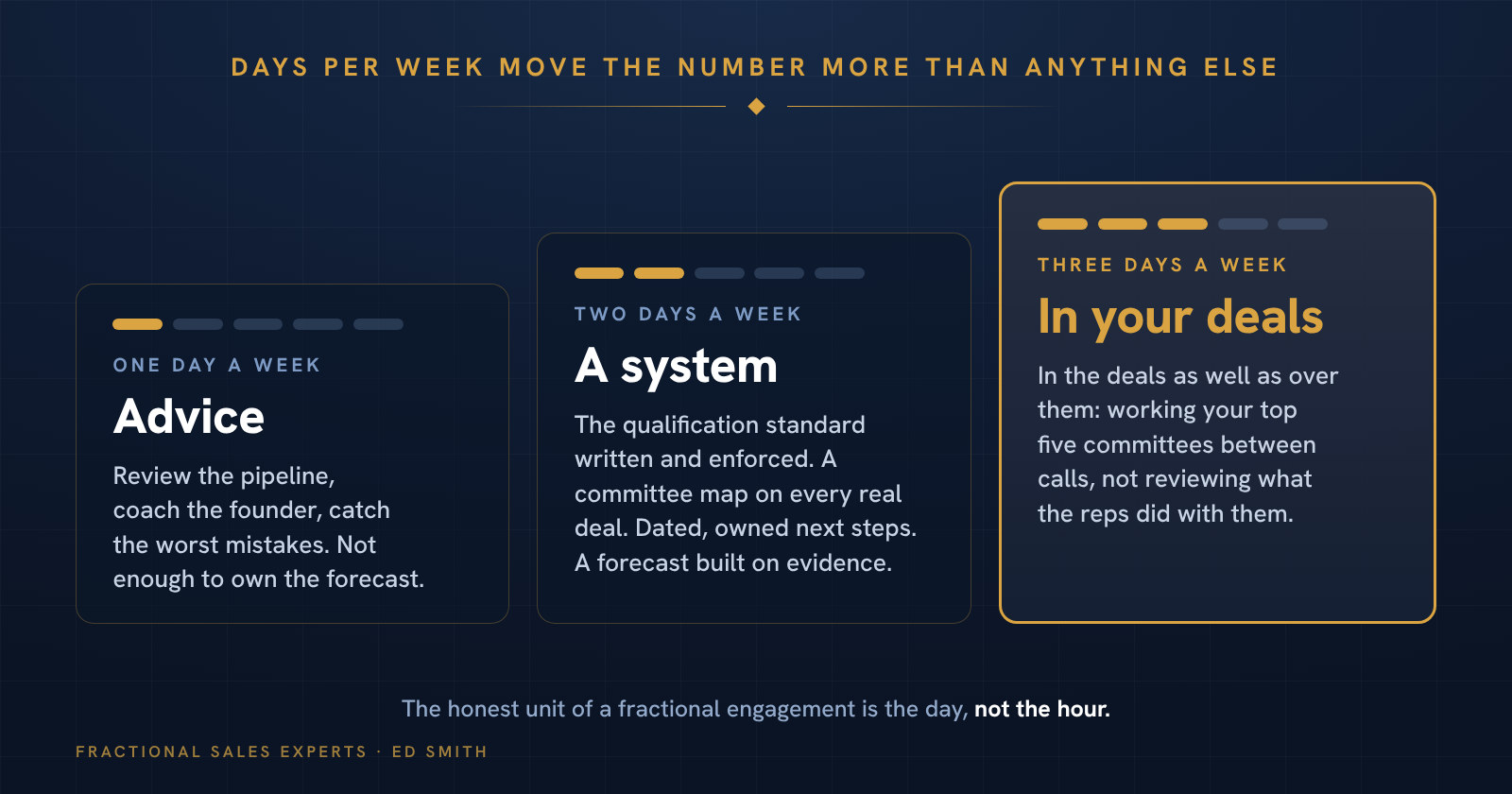
One day a week is advisory with a retainer label on it. I can review the pipeline, coach the founder, and catch the worst mistakes. I cannot own the forecast on one day, and I will not pretend to.
Two days a week is enough to own the system. The qualification standard gets written and enforced. Every real deal gets a committee map. Next steps get dates and owners. The forecast gets built on evidence instead of feelings with a spreadsheet around them. That is what I help founders run on most engagements.
Three days a week is enough to be in the deals as well as over them. The difference between two and three is not fifty percent more meetings. It is whether I am working your top five committees between calls or reviewing what your reps did with them.
When a founder asks me to price something, days per week is the first question I ask back. It is also the first thing I would ask anyone else.
In the deals costs more than beside them
Beside the deals means I review, coach and correct. I see every opportunity in the weekly cadence and I tell you where the committee is unmapped and where the next step has no date. Your team does the selling.
In the deals means I am on the call with the economic buyer. I work the CIO, InfoSec and procurement between calls. I write the mutual close plan and own it. On a retail technology deal that means I know the merchant's calendar and the incumbent's renewal date before the champion tells us (selling software into retailers).
That takes more of my calendar and much more of my attention. It moves the number up, and it should. Anyone who prices "in the deals" the same as "beside the deals" is going to be beside them.
Two other things move the number. Travel is one. I am in Scottsdale, Arizona, and most engagements run remotely (how a remote engagement runs). A day on-site at a retailer's headquarters or a quarterly planning session is priced as travel, not buried in the retainer.
The other is a hire-and-handoff project. Writing the scorecard, running the search, interviewing finalists against the motion that now exists, and onboarding the hire into it. That has a start and an end, so it is priced as a project under Special Projects. It is not a retainer that quietly runs on.
A retainer is cheaper than a full-time VP, but cheaper is not the point
The arithmetic favors fractional at this stage. Every competing page will show you that math, so I will keep it short.
Base salary is the smallest piece of a full-time VP. Add payroll load and benefits. Add a recruiter's fee. Add equity that is gone whether or not it worked. Then add the cost of a miss. A full-time VP hired to invent a motion that does not exist usually fails and takes a year with them. The tenure figure above says that is a common outcome, not a rare one.
A two-day retainer is a fraction of that loaded cost, carries no equity, and ends on thirty days' notice. That is true and it matters.
But cheaper is not why you would do it. At roughly $1M to $5M ARR, with deals that move through a champion, an economic buyer, IT, InfoSec, finance and procurement, what you need is a motion. You do not need a department yet. A fractional leader builds the motion, proves it, and then helps you hire into it. The full-time VP who inherits a working motion tends to stay (when do you need a VP of Sales).
If the trigger is committee complexity and not revenue, the question is not "which costs less." The question is "which one is built for the problem I have."
Why the exact figure waits for the first call
The day rate and the ranges above are real. The exact monthly figure is scoped on the first call, after the work is mapped. Here is the reason.
A rate card prices the shape. The first call prices the problem. Two founders can both ask for "two days a week" and need very different things. One has eight real deals, a rep who can run discovery, and a forecast that is almost honest. The other has a pipeline of enthusiastic contacts whose economic buyers have never heard the company's name. Same shape on paper, different work.
In that call I map the pipeline, the committee on your top deals, who is actually selling today, and what the ending should look like. Then I tell you which shape fits and what it costs. The number does not change after that unless the work does.
A full rate card would do one of two things. It would anchor you to a shape before we know the problem, or it would make me price every engagement for the hardest case. Neither is good for you. So you get the rate and the ranges here, and the number after the map.
If you leave the first call with a number and no map, you got a quote. You did not get a plan.
How to compare quotes from different fractional leaders
You will probably talk to more than one of us. Good. Ask every one of us the same three questions, including me.
What do you own? The answer should be nouns. The qualification standard. The committee map. The forecast. The weekly cadence. If the answer is "strategy" or "support," you are buying advisory at a retainer price.
Are you in the deals or beside them? Either answer can be right. What matters is that the quote matches the answer. A leader who is beside the deals should cost less than one who is in them.
How does this end? The ending should be named at the start. A motion that runs without them. A full-time hire they help you make. Or continued advisory at a lighter shape. I work on a ninety-day minimum and then thirty days' notice. A quote with no named ending is a subscription, and subscriptions tend to renew whether or not they are working.
One more. Watch the title. Some leaders will quote the same work under a bigger title and a bigger number. I have written about fractional CRO vs fractional VP of Sales, and the short version is that the title matters less than what the person owns on Monday morning.
What to do about it
Decide days per week before you talk to anyone. One day is advice. Two days is a system. Three days is someone in your deals. Be honest about which one your pipeline needs.
Write down what you want the leader to own, in nouns. If you cannot list it, no quote will be comparable to another.
Decide whether you want them in the deals or beside them. If you are still the only person who has met your economic buyers, "in" is probably the answer.
Name the ending before the start. A working motion, a hire, or ongoing advisory. Put a date on the first checkpoint.
Compare quotes on those four things, not on the monthly number. The cheapest quote with no ending is the most expensive one.
Then check the fit in two minutes. If it fits, the first call maps the work and scopes the investment.
Questions founders ask
Is a fractional VP of Sales paid hourly or on a retainer?
Both exist. Hourly and day-rate billing is common for advisory work where you keep running sales. A monthly retainer at a fixed number of days per week is the norm when the leader owns the system. That means the qualification standard, the committee map, the forecast and the weekly cadence. The retainer is the right shape when you want someone accountable on Monday morning.
How many days a week do I need a fractional VP of Sales?
Two days a week is enough to build and own a sales system at the $1M to $5M ARR stage. Three days a week is the shape when you need the leader in the deals as well as over them. That is usually because the founder is still the only person who has met the economic buyers. One day a week is advisory, and it should be priced and described that way.
Is a fractional VP of Sales cheaper than a full-time VP of Sales?
Yes, by a wide margin, once you count payroll load, a recruiter's fee, equity and the cost of a miss. Public benchmarks put a full-time US SaaS VP of Sales at a six-figure base before variable pay and equity, and average tenure under two years. A fractional retainer carries no equity and ends on thirty days' notice. Cheaper is not the reason to choose it, though. The reason is that most companies at this stage need a motion, not a department.
How long does a fractional VP of Sales engagement last?
Mine run on a ninety-day minimum, then month to month with thirty days' notice. Most engagements run several quarters, because building a motion and proving it takes more than one. The ending is named at the start: a motion that runs without me, a full-time hire I help you make, or continued advisory at a lighter shape.
Why won't a fractional sales leader just tell me their rate?
Because a rate prices the shape and the first call prices the problem. Two founders can ask for the same two days a week and need very different work. I map the pipeline, the committees on your top deals and the ending you want, then tell you which shape fits and what it costs. If a leader quotes before mapping, you are getting a number, not a plan.
What should I ask when comparing fractional sales leaders?
Three things. What do you own, answered in nouns. Are you in the deals or beside them, and does the price match the answer. How does this end, with the ending named before the start. Compare quotes on those, not on the monthly figure. A low quote with no named ending usually costs the most.
How much does a fractional VP of Sales cost?
The number is set by days per week, whether the leader is in your deals or beside them, travel, and whether a hire-and-handoff project is included. Published market sources put fractional sales leaders anywhere from a few thousand dollars a month for light advisory to the mid teens and above for an embedded leader several days a week; Vendux reports an average of $225 an hour in 2025. My own work: advisory at $2,000 a day or $250 an hour; retainers from the mid-teens a month at two days a week to the mid-twenties at three. The exact figure is scoped on the first call, after the work is mapped.
More on the work: Advisor, fractional VP of Sales and special projects · Check the fit
More notes

A Valley founder's first enterprise deal
What the first enterprise deal looks like for a Greater Phoenix founder, and what changes when your startup sales leader in Phoenix can sit in the deal review.

Your VP of Sales didn't work out. Now what?
Your VP of Sales didn't work out. Here is why it usually wasn't the person, what to do in the first two weeks, and the two moves that make it worse.