Search and AI
How founders get cited by ChatGPT and Perplexity
Buyers now ask AI assistants who to shortlist before they open a search page. Five moves a founder-led company can make this month to be named in those answers.

Buyers now ask ChatGPT, Perplexity, Gemini and Claude who to shortlist before they open a search results page. If your company is not in those answers, you are not on the list, and you will never see the deal that didn't happen.
For founder-led B2B companies, that is better news than it sounds. AI assistants answer with specifics, and a small company that is clear about who it serves can be named right next to the big players.
Here is what I would do this month.
Be the easiest answer to quote
AI assistants lift answers that are clear, specific and self-contained. Take the five questions your buyers ask most often. Give each one a page. Put the plain answer in the first two sentences, then back it up with detail, examples and your point of view.
Vague positioning gets skipped. A direct sentence about who you serve and what you fix gets reused.
Say it the same way everywhere
Models build a picture of your company from many places: your site, your LinkedIn page, directories, interviews, podcasts. When those places describe you in the same words, the picture is sharp. When each one tells a different story, it blurs.
Pick one sentence that names your buyer, the problem you solve and the category you play in. Use it on your homepage, your profiles and your bio.
Earn mentions on sites you don't own
In what I see, models lean on third-party validation more than a company's own site. Press mentions, expert roundups, directories, podcasts and community discussions carry weight.
That changes where a founder spends time. One credible mention on an outside site often does more than another page on your own domain. Answer writer and journalist source requests. Pitch podcasts. Contribute to publications your buyers read. Ask for a link to your website every time, so the mention points back to you.
Track it like a pipeline report
You cannot improve what you do not measure, and this is measurable with a simple routine.
Write 20 to 30 questions a real buyer would ask. Mix category questions ("who helps founders build a repeatable sales process?") with comparison and problem questions. Run them monthly across ChatGPT, Perplexity, Gemini and Claude. For each one, log three things: are you mentioned, are you cited with a link, and who is named next to you.
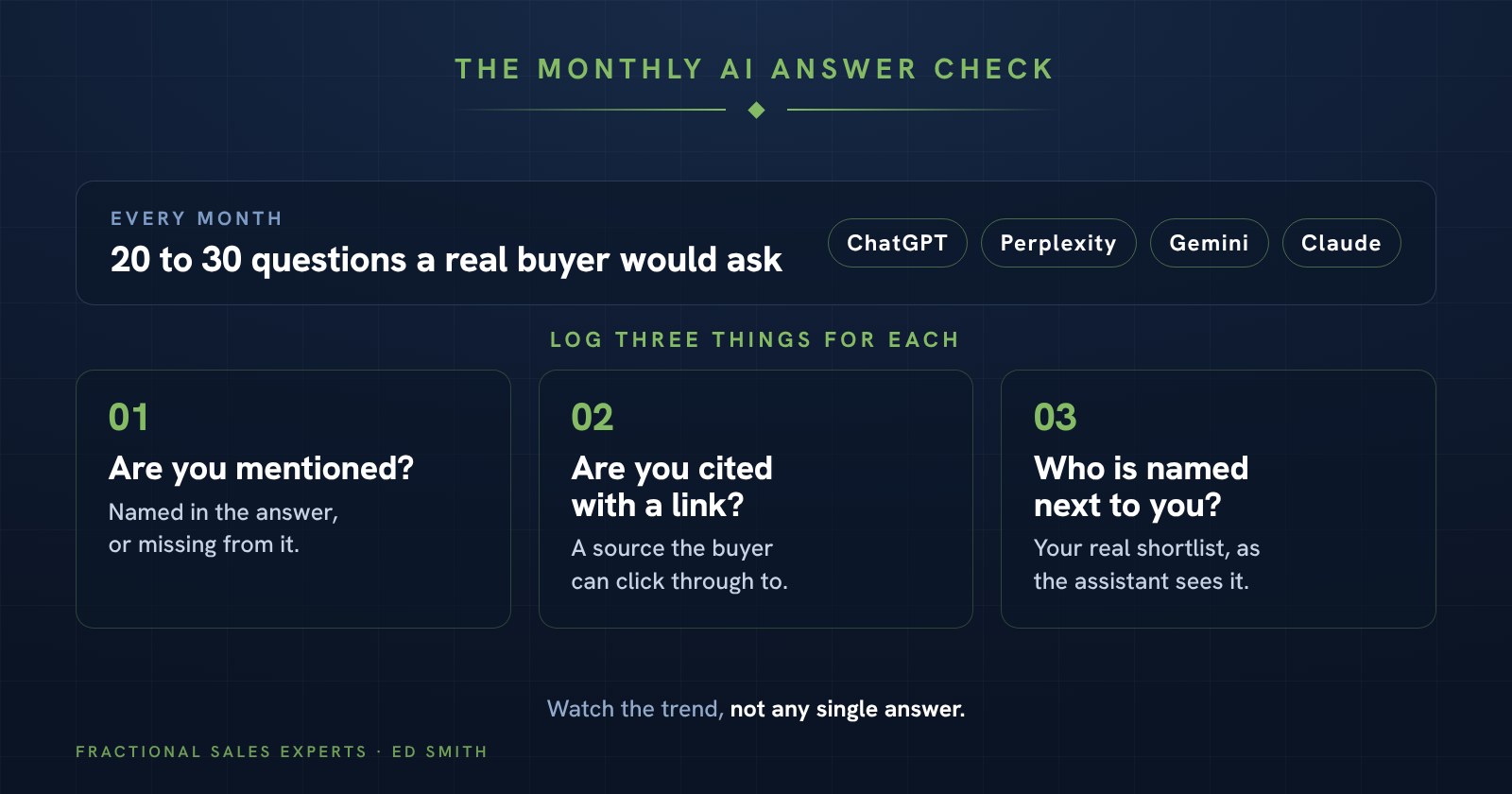
Watch the trend, not any single answer. Outputs shift from run to run, so a month-over-month pattern tells you more than one lucky or unlucky result. Dedicated tracking tools exist if you want to automate it. A spreadsheet is enough to start.
Let your sales calls write the content
The best source of material is your sales team. Every objection, pricing question and "how do you compare" a buyer raises on a call is a question someone will eventually type into an AI assistant. Send those questions to whoever writes your content, and publish pages that answer them directly.
This is also where classic search and AI answers meet. Both reward pages that answer what buyers actually ask. The difference is the prize. Classic search competes for the click. AI answers compete for the shortlist, and in a complex sale the buyer often arrives already holding one.
Your first 30 days
- Write your one-sentence description and use it everywhere.
- List your top five buyer questions and publish a direct-answer page for each.
- Build the 20 to 30 question tracking sheet and run the first baseline.
- Pitch three outside sources: one publication, one podcast, one writer request.
- Run the sheet again in 30 days and compare.
The takeaway
This rewards the same habits that make a good salesperson: be specific about who you serve, say it consistently, and get others to say it about you. Founders who start now are building a position while most of their competitors are still deciding whether it matters.
I am running the same steps on my own site.


